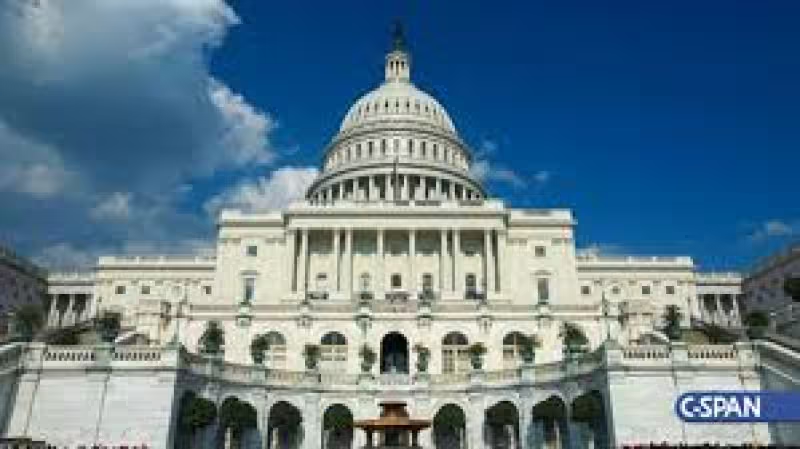
The House of Representatives voted early Friday to briefly extend Fisa 702, the surveillance law that lets the government collect and review some communications without a warrant. The stopgap move pushes the deadline to April 30, averting an immediate lapse in a law that was set to expire on Monday.
Lawmakers approved the short extension by unanimous consent after 208 Democrats and 20 Republicans joined to defeat attempts at five-year and 18-month renewals. Section 702 of the Foreign Intelligence Surveillance Act, first enacted in 2008, allows national security agencies to gather texts and emails sent to and from foreigners living outside the country without a warrant, and it also covers communications between Americans and non-American targets abroad.


The vote came as Donald Trump pressed for an 18-month extension and defended the program on Truth Social as an effective tool to keep Americans safe and extremely important to our military. Two years ago, Trump was calling to KILL FISA after accusing the FBI of misusing the law to spy on his 2016 campaign, a reminder of how politics around the program can turn on who is being targeted and who is holding the power.
Supporters of Section 702 say the law has helped in real-world operations, with the CIA crediting it for aiding the rescue of hostages overseas and helping prevent a terror attack at a Taylor Swift concert in Vienna. Critics counter that the same authority lets the government spy on Americans without a warrant, and Ro Khanna said on X that it gives Donald Trump the power to surveil or collect data on Americans through a back door. He added that a yes vote gives Trump more power to surveil Americans and urged Democrats and constitutional conservatives alike to vote no.
The short extension does not settle the larger fight over fisa 702. It only buys time, and that time now runs to April 30, when Congress will have to decide whether to keep the surveillance authority in place, rewrite it, or let the debate return at full force.