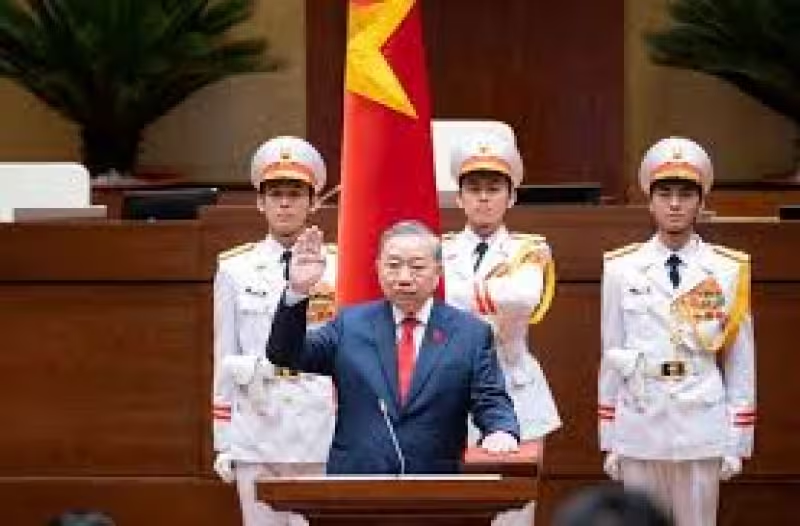
Vietnam's lawmakers unanimously elected Communist Party chief To Lam as state president on April 7, giving the 68-year-old leader another five-year term at the top of the one-party state. The National Assembly said all 495 deputies present endorsed the party's nomination, while five lawmakers were absent from the session.
Lam, who had already secured a second term as general secretary in January, told deputies in a televised address that it was an honor to hold both posts. Parliament was scheduled later on April 7 to elect a new prime minister to replace Pham Minh Chinh, completing another reshuffle at the top of Vietnam's leadership.
Officials said the nominations for the highest state jobs were finalized in a meeting in late March. Lam had held both posts for a period of a few months after the death in 2024 of party General Secretary Nguyen Phu Trong, before later handing the state presidency to army general Luong Cuong. Even after that, Lam often acted as if he had retained the role, keeping him close to the center of power as he pushed an agenda of economic change.



Read Also: Cia Director David Petraeus: Ukraine's drones and the new command system
In his remarks, Lam said his priorities were to maintain stability, promote rapid and sustainable national development, and improve all aspects of people's lives. He said Vietnam would prioritize a new growth model with science, technology, innovation and digital transformation as the main drivers, alongside self-reliance in defense. He has also vowed to pursue double-digit growth through a development model less dependent on low-cost manufacturing, and has backed the expansion of private conglomerates. Before his reappointment, however, Lam issued a directive emphasizing the leading role of state-owned enterprises.
Vietnam has long relied on collective leadership rather than concentrating state power in one person, which is why Lam's accumulation of authority has drawn close scrutiny. Le Hong Hiep, a political analyst, said concentrating greater power in Lam's hands could pose risks to the political system, including increased authoritarianism, even as it could also allow Vietnam to formulate and implement policy more quickly and effectively. Alexander Vuving said the move would shift domestic politics to a new normal in which many old assumptions about Vietnam's leadership, including collective rule, are no longer valid. That makes the next phase of Lam's rule less about the title he now holds than about how far he can reshape the system around it.