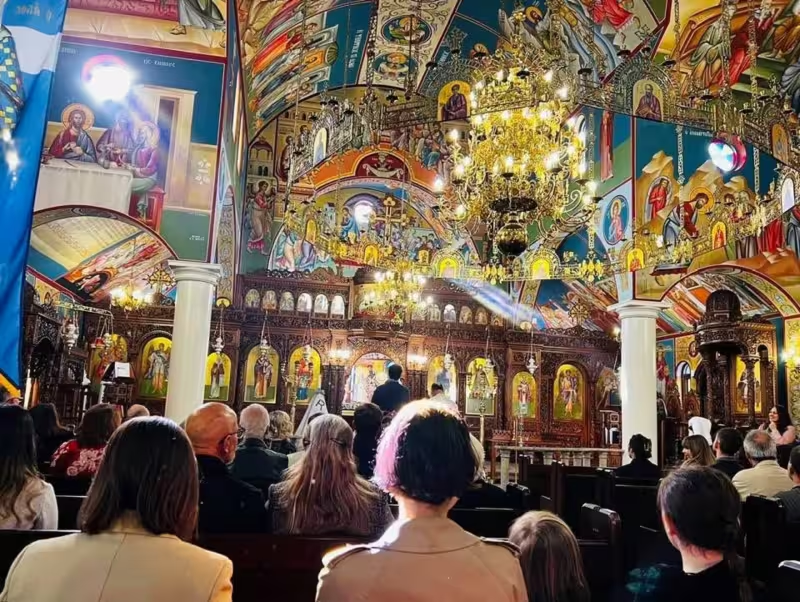
He says Jesus rose last weekend as a Catholic and will rise again next Sunday at 12am, and he is going to be there for it. The writer of Twice risen: An atheist's Pascha says the great absurdity is that he does not believe in God, yet as he ages, he takes greater joy in Pascha, the Easter observance he describes as Passover, or Pecha, in the Eastern Orthodox tradition.
That life will gather around his son, Anastasios, and a night ceremony that still feels larger than the modern world trying to contain it. On Saturday night just before midnight, father and son will attend Anastasi, arriving at 11.45pm with large candles, or lambathes, wrapped in foil windbreakers, then joining Byzantine chant to sing Christos Anesti, or Christ has risen.
The ritual is not only theirs. When his wife once remarked, “It’s not just you guys that have Easter,” he answered by pointing back to a family conviction that runs through the observance: “we’re the first, and we have not changed for 2000 years.” The line is half boast, half inheritance. It carries the certainty of people who have kept a calendar through migration, grief and distance, and who still measure time by the same feast.
Read Also: Adilei Brown Takes Second in 2026 Cspan StudentCam
He places that inheritance in the everyday details of his childhood in Adelaide in the early 1970s, when his mother secretly fed him milk and Coco Pops during the 40 days of fasting. He also reaches across cultures with the mention of Spaniards eating potaje and torrijas on Good Friday, a reminder that Easter is never one thing in one country, even when it feels immovable to the families who keep it.



The weight of the story sits in the names. His father was called Anastasios, and Easter Sunday was his name day. He died at 62, but the name remains in the family through his son, who carries it forward into the midnight liturgy. That is why the feast is not abstract for him. It is not a doctrine first and a memory second. It is a father, a son, a candle, a chant and a promise repeated out loud in the dark.
Read Also: Pat Mcafee return in WWE title angle sparks backstage frustration
That promise has survived because it has always been braided into history. The writer links Easter to Greek identity, migration and historical trauma, including the Nazis in Greece and the Greek Civil War. He also recalls Archbishop of Athens Damaskinos, who saved thousands of Greek Jews, placing the observance inside a broader moral history where survival and conscience are part of the same inheritance. Even his father’s anti-clerical streak did not break that chain; Easter still mattered because the family made it matter.
The friction in the piece is that the writer stands outside belief while moving more deeply into the ritual as he gets older. He says he does not believe in God, yet Pascha gives him greater joy now than it once did. That contradiction does not weaken the observance. It sharpens it. What he is drawn to is not certainty but continuity, the stubborn insistence that a family can keep returning to the same night, the same words and the same candlelight even when faith and doubt sit at the table together.
So the answer to the question raised by the headline is plain enough. Twice is not a joke about Easter on two calendars. It is the story of a man who has lost belief but not attachment, and of a family that treats resurrection as both liturgy and lineage. Next Sunday at 12am, in his telling, Jesus will rise again — and for his family, that repetition is exactly the point.