Turkey is advancing the £20 billion Istanbul Canal, a planned toll-based shipping route that would run parallel to the Bosphorus Strait and link the Black Sea with the Sea of Marmara. The waterway is designed to handle around 160 vessels or oil tankers each year and is expected to be completed by 2027.
The scale is split between £12 billion for the canal itself and £8 billion for development on either side, according to the project figures. President Recep Tayyip Erdogan described Canal Istanbul in 2021 as a project to save the future of Istanbul, saying it would ensure the safety of life and property along the Bosphorus and for the citizens living around it.
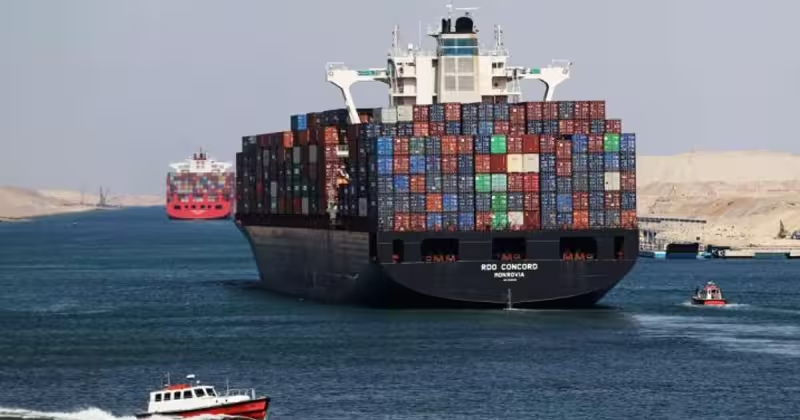
The push comes as Turkey looks at the Suez Canal, one of the world’s most profitable waterways and a major source of foreign currency for Cairo, as a model for what a man-made route can generate. Egypt’s canal, along with Panama’s, can charge tolls because they are artificial waterways. By contrast, under the United Nations Convention on the Law of the Sea, ships using natural straits for international navigation have transit passage rights and bordering states cannot demand payment for passage, though limited service-related charges are allowed.
Read Also: Erdogan says Turkey could confront Israel militarily after sharp Gaza tirade



That legal distinction is at the heart of Turkey’s plan. A parallel artificial canal beside the Bosphorus would let Ankara introduce structured tolls without violating international law, a calculation that has drawn fresh attention as tensions around the Strait of Hormuz have sharpened interest in alternative maritime chokepoints. The Bosphorus and the Strait of Hormuz remain natural straits, and that means the fee-based model that makes the Suez Canal so lucrative cannot simply be copied there.
The financial stakes are clear from recent Suez figures. Between January 1 and February 8, 2026, the canal brought in $449 million as 1,315 ships passed through it. Over 2019 to 2024, it generated about $40 billion. The Suez Canal Authority now forecasts about $8 billion in revenue for the 2026/2027 fiscal year, rising to roughly $10 billion in the following year.
Read Also: Uganda army chief Muhoozi demands $1 billion and wife from Turkey
For Turkey, that is the attraction and the test. If the Istanbul Canal is finished by 2027, it would stand as a rare example of a new strategic waterway built not just to move ships, but to turn geography into a revenue stream.