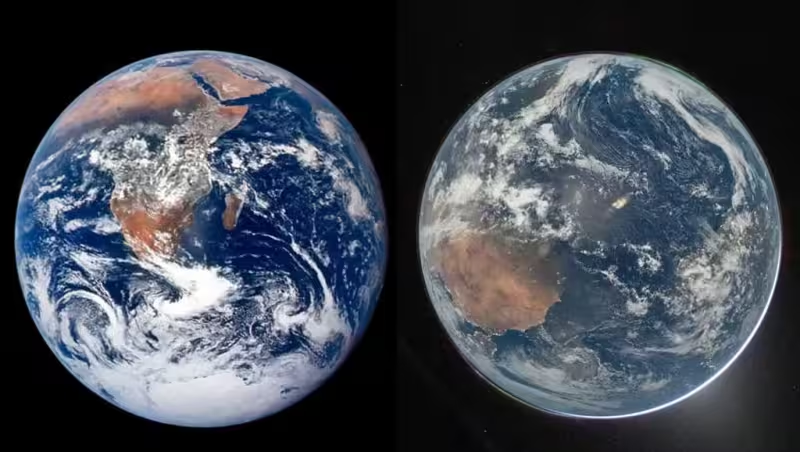
The Artemis 2 crew will try to catch Earthset as the planet slips below the lunar horizon when the mission swings around the far side of the moon on Monday, April 6. If the view lines up, the astronauts hope to recreate the Earthrise image more than 57 years after Apollo 8 first took humans around the moon.
That means the crew will be looking for the kind of picture Bill Anders stumbled into on Christmas Eve 1968, when Earth appeared in the window during Apollo 8’s fourth orbit and he blurted, “Oh my god, look at that picture over there!” and then, “There’s Earth coming up. Wow, is that pretty!” Anders reached for a Hasselblad camera fitted with a 250mm telephoto lens and shot the frame that became known as Earthrise, even as Frank Borman quipped, “Hey, don't take that — it's not scheduled,” and Anders realized he had a roll of black-and-white film in the camera and asked Jim Lovell for the color film.
That photograph, showing Earth as a blue marble rising above the barren lunar surface, was taken unexpectedly during Apollo 8’s 10 orbits and went on to become perhaps the most famous image ever taken from space. It also became the poster child for anti-war and pro-environment campaigners, giving the image a life far beyond the mission that captured it.

Read Also: Artemis Photos show Earthset, eclipse and moon’s far side in rare flyby
Artemis 2 is different in one important way: the spacecraft will swing around the moon’s far side just once and will not enter lunar orbit, unlike Apollo 8’s 10 laps. The new crew’s shot at Earthset is timed for the same basic geometry that made the earlier image possible, with Earth appearing over the horizon as the spacecraft comes around from behind the moon. Whether the new picture lands with the same force as Earthrise will depend on the angle, the light and the luck of a moment that cannot be planned twice.
Read Also: Charlie Duke and Artemis II get Lovell's last moonbound message
But the appeal is clear before the camera even clicks. More than 57 years after Apollo 8, Artemis 2 is not just revisiting a route around the moon; it is reaching for a picture that changed how people saw the planet itself. If the crew gets the frame it wants on April 6, the answer to what it is trying to do will be sitting right there in the image.