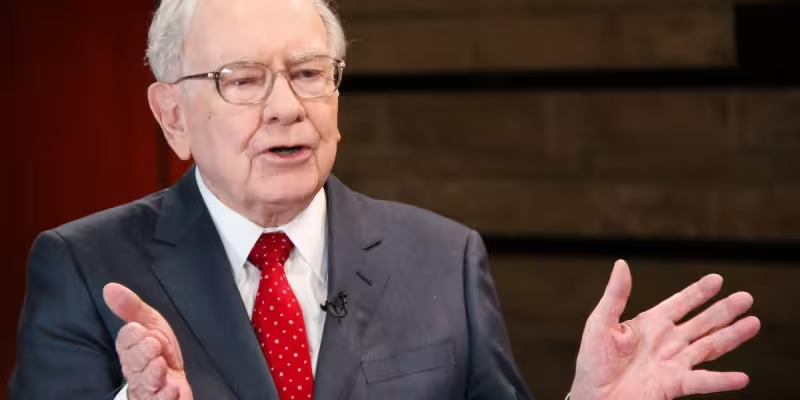
Warren Buffett is 95, worth $143 billion and still lives like a man who would rather save a buck than spend one. In the final Berkshire Hathaway shareholder letter he wrote last November, he said greatness does not come from piling up money, publicity or power in government.
That idea has always run through Buffett’s public life. He is the 13th richest person in the world, but for decades he has been known for McDonald’s runs, a beat-up old car and the same modest Nebraska home he bought in 1958. He once took Bill Gates to McDonald’s for lunch instead of a swanky restaurant, and Gates later recalled laughing when Buffett pulled coupons from his pocket to pay for a meal in Hong Kong.
Buffett’s words have often matched the way he has lived. He has said, “When you help someone in any of thousands of ways, you help the world,” and, “Kindness is costless but also priceless.” He has also urged people to remember that “the cleaning lady is as much a human being as the Chairman.” The message is less about wealth than conduct, and it has become part of the public case he leaves behind as he steps back from writing shareholder letters.
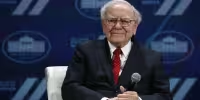
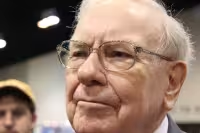
The numbers make the contrast sharper. Buffett’s fortune stands at about $143 billion, yet he has long favored the kind of habits that make his life look almost stubbornly ordinary. At McDonald’s, he has been known to order two sausage patties, an egg and cheese, or a bacon egg and cheese, meals that cost less than $4. He once drove a 20-year-old car because he thought it was safer than a faster luxury model, and at one point his license plate read THRIFTY.
The Omaha home ties the story together. Buffett bought the five bedroom, two-and-a-half bathroom house for $31,500 in 1958, and it would be worth around $1.4 million today. He has said he would not trade it for anything, and that the appeal is not the price but the years he spent raising his three children there. It is the same house he has lived in since then, a private anchor that sits uneasily next to the scale of his fortune.
That tension has always made Buffett harder to reduce to a simple billionaire caricature. He has said he does not think standard of living equates with cost of living beyond a certain point, a view that helps explain why one of the richest people in the world still treats thrift as a virtue rather than a compromise. For Buffett, the lesson is not that money is unimportant. It is that money, by itself, is not the point.