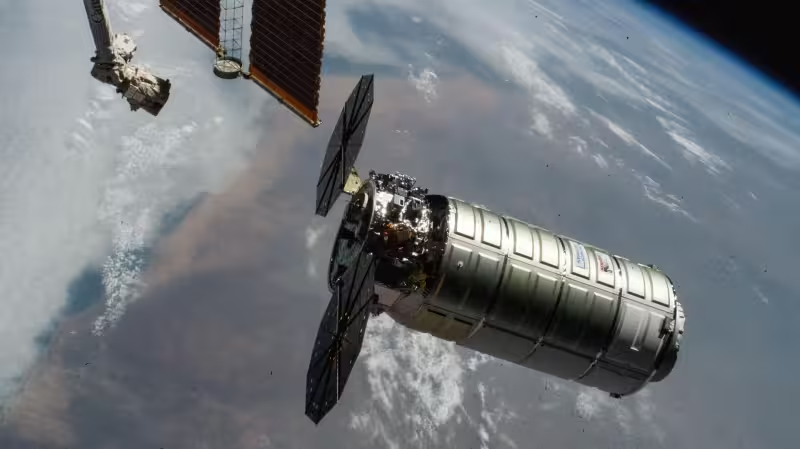
Northrop Grumman’s Cygnus XL cargo spacecraft is set to launch atop a SpaceX Falcon 9 rocket at 7:41 a.m. EDT on Saturday, beginning a resupply run to the International Space Station for the Expedition 74 crew. Packed with more than 11,000 pounds of lab hardware, science experiments and crew supplies, the spacecraft is due to arrive Monday and be captured by the Canadarm2 robotic arm.
NASA flight engineers Chris Williams and Jack Hathaway practiced the capture on Friday during a computer simulation, training on the robotics workstation’s control panel and hand controllers to maneuver Canadarm2. Williams is scheduled to be at the controls Monday, while Hathaway will monitor Cygnus XL’s approach and rendezvous. After capture, mission controllers will remotely guide the arm to install the spacecraft on the Unity module’s Earth-facing port, where it will remain for a six-month mission.

The flight is part of the steady freight pipeline that keeps the orbiting laboratory stocked, and this load includes hardware and experiments tied to some of the station’s most specific work. Among the cargo are a quantum physics module to expand the Cold Atom Lab, a blood stem cell study aimed at treating cancers and blood disorders, and an investigation focused on astronaut gut health.
While Cygnus XL makes its approach, other work is already under way aboard the station. Williams, Hathaway, Jessica Meir and Sophie Adenot discussed cargo operations after the hatches are opened, while in the Roscosmos segment Sergey Kud-Sverchkov and Sergei Mikaev recorded their rapid exhalation using an acoustic sensor around their necks. Andrey Fedyaev also continued testing artificial intelligence tools meant to improve space crew operations and communications.
NASA plans to stream the launch and arrival coverage on NASA+, Amazon Prime and the agency’s YouTube channel. For the station crew, the key moment comes Monday: a new cargo ship to catch, unload and put to work, with the next six months shaped in part by what is inside it.