
Former NASA Administrator Bill Nelson said the successful splashdown of the Orion spacecraft marks a critical step toward sending humans back to the moon and, eventually, on to Mars. He said the landing closes a key chapter in a program that is moving from test flights to crewed missions and, later, to lunar landings.
“It’s the first time in a half a century that we’ve gone back to the moon,” Nelson said. He said Artemis I flew without astronauts to test the rocket, while Artemis II put a crew aboard to check life support systems. Future missions will practice docking maneuvers before two astronauts land on the lunar surface for six days.
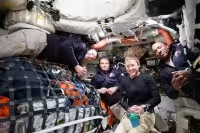
Nelson said the journey is still hazardous. “When you fly in space, it’s highly dangerous,” he said. He also said the Artemis II crew includes the first international astronaut to travel to the moon, a milestone he cast as part of the broader effort to return to deep space after decades spent mostly in orbit close to Earth.
Read Also: Rocket Landing Today: SpaceX plume lights up Southern California skies


The former administrator framed that progress against a new competition. China’s military space program has pledged to land astronauts on the moon by 2030, and Nelson said that has revived a space race, “not with the Soviets, this time with the Chinese.” He said that was good news, but added that it comes as China is cutting science, including Earth science, even though spaceflight has taught humanity how fragile the planet is.
Nelson said the United States has “taken the next step toward establishing a moon base,” and said the effort is about more than building on the lunar surface. He said it is about developing technologies that can improve life on Earth and prepare the country for the next leg of exploration. “And I think within about 15 years, you’ll see us going to the planet Mars,” he said.
Read Also: Meteor Fireball Streaks Across Tri-State Sky, Seen in Five States
He placed the Artemis program in the broader revival of Florida’s Space Coast, which he said is projected to see around 140 launches this year, up from roughly 10 to 15 launches just a few years ago. The surge reflects how quickly the launch corridor has rebounded since the shuttle program ended in 2011, turning the state back into one of the country’s busiest windows on space.
The next phase will tell whether NASA can turn the Orion test flight into a sustained cadence of crewed lunar missions. Nelson said the answer now depends on the program’s ability to keep stacking steps, from the Moon to Mars, without losing the science and safety that got it this far.