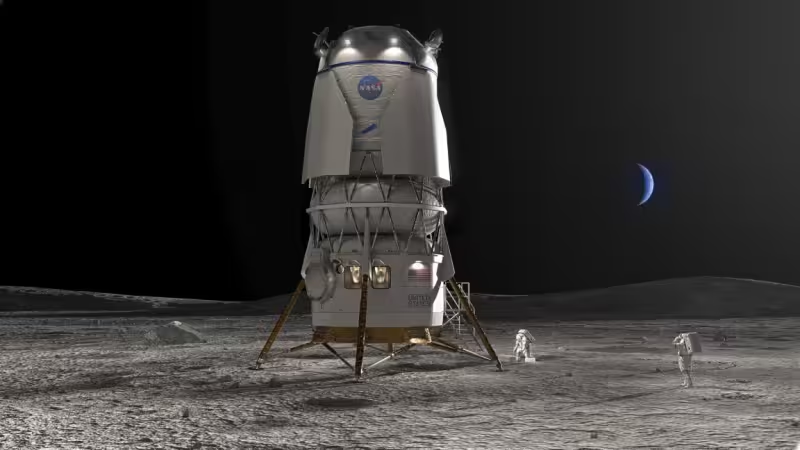
NASA is still deciding where Artemis 4 will fly, with the agency weighing whether the mission’s first orbit around Earth should be low-Earth orbit or high-Earth orbit before Orion is cleared for the next lunar step. Administrator Jared Isaacman said Tuesday afternoon that the agency was debating the blueprint after the first senior-level Artemis III mission design discussion earlier in the day.
“One of the questions is what the initial orbit will be for Artemis III,” Isaacman said. “Is it going to be LEO or HEO? There are pros and cons for each of them, for sure.” The choice matters because Artemis III is the new Earth-orbit mission NASA inserted six weeks ago when it modified its Artemis timeline to add a risk-reduction flight before planned lunar landings.
Under the revised plan, Artemis III will not go to the Moon. Instead, Orion will launch from Florida on a Space Launch System rocket, presumably carrying four astronauts, and rendezvous in Earth orbit with one or both of NASA’s Human Landing Systems, SpaceX’s Starship upper stage and Blue Origin’s modified Blue Moon lander. NASA wants the mission to buy down risk so the lunar landing flight that follows has a higher chance of success, and Isaacman said the agency’s preference is to test with both landers to gather performance data and build handling confidence.
Read Also: Spacex Starship Engine Test ends in blast at Starbase, Texas



The orbit decision will shape the rest of the mission in a practical way. A rendezvous in low-Earth orbit, about 160 kilometers to 2,000 kilometers above Earth, could let NASA fly the SLS rocket without using its Interim Cryogenic Propulsion Stage, preserving the final remaining ICPS for Artemis IV and allowing future SLS missions to rely on a Centaur V upper stage from United Launch Alliance. A high-Earth orbit rendezvous, more than 36,000 kilometers from Earth and above geosynchronous orbit, would require the ICPS to push Orion there, but it would better match the thermal environment near the Moon and provide a sterner test for Orion’s modified heat shield.
The closest Apollo-era parallel was Apollo 9, which flew in low-Earth orbit between 200 kilometers and 500 kilometers. NASA is trying to decide whether that lower-altitude test is enough or whether a higher orbit gives the agency a better rehearsal before it commits to lunar landing operations. Isaacman said a mission in 2027 could make testing with both Starship and Blue Moon possible, and that point may decide which orbit NASA chooses. The agency has the hardware and the schedule pressure in view at once: Starship V3 is in final testing ahead of a debut launch that could happen in about a month, while Blue Origin’s Blue Moon Mk. 1 lander is wrapping up vacuum-chamber testing at Johnson Space Center in Houston.
Read Also: Rocket Landing Today: SpaceX plume lights up Southern California skies
Friday evening, Artemis II is expected to return to Earth with a splashdown in the Pacific Ocean off San Diego. What comes next is now clearer than it was six weeks ago: NASA is treating Artemis III as the mission that must prove the pieces can work in Earth orbit before Artemis IV aims for the Moon.