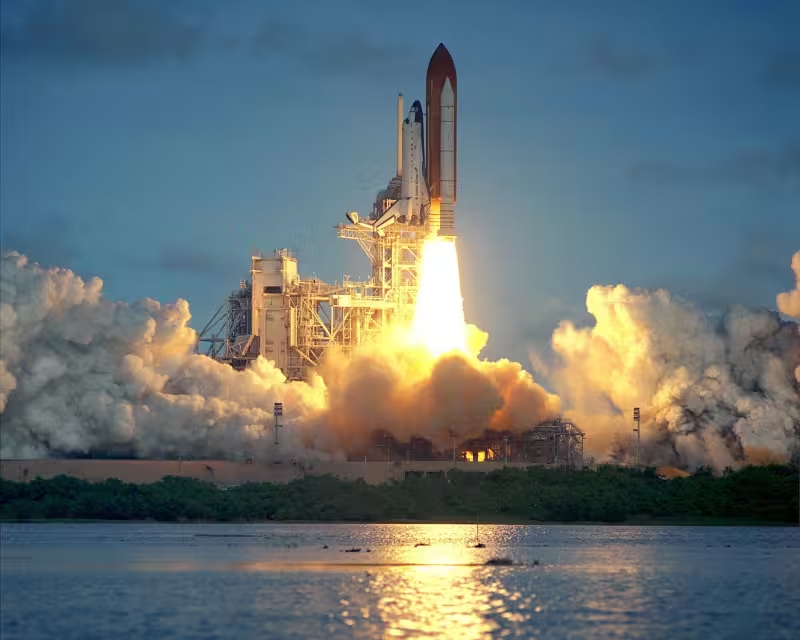
NASA’s Artemis II spacecraft is nearing its final recovery phase in the Pacific, putting splashdown back in the spotlight as marine scientists and environmental lawyers question whether the ocean is as harmless a landing zone as it has long been portrayed. For decades, controlled re-entry into the sea has been treated as the safest finish to a mission. Now that assumption is under pressure.
Splashdown means a spacecraft slows through the atmosphere, deploys parachutes and lands in the ocean. NASA’s environmental assessment says water landings are favored because the ocean absorbs the kinetic energy of a descending capsule, reducing structural damage and lowering crew risk during descent. The method has deep roots in U.S. spaceflight, having been used for Mercury, Gemini and Apollo, and it remains in use for modern crew capsules such as Orion and SpaceX’s Dragon.
The concern today is not whether a capsule can survive the trip. It is whether the impact zone leaves a larger mark on the sea than earlier assessments allowed. Marine biologists and environmental lawyers are pointing to acoustic shockwaves, residual propellants and the long-term accumulation of debris on the seafloor. Research on water impacts has shown that entry into water generates shock waves and acoustic energy that can spread through the marine environment, although NASA’s own assessment says those effects are generally short-lived and expected to trigger startle reactions in fish and marine mammals rather than physical harm.
Read Also: Spacex Starship Engine Test ends in blast at Starbase, Texas
The debate lands just as NASA’s Artemis II mission nears its Pacific recovery, making the issue current rather than theoretical. The agency has historically leaned on the idea that splashdowns have a limited footprint and that the ocean absorbs impact energy. A U.S. Federal Aviation Administration environmental assessment reached a similar conclusion, saying capsule-sized splashdowns are unlikely to harm marine species because the impact zone is small. Those findings have helped justify the continued use of remote Pacific recovery areas.
But the new criticism is focused on what happens beyond the first splash. Scientific modeling of spacecraft and sonic boom interactions with water suggests pressure waves diminish rapidly with depth, yet researchers say that does not fully settle the question of repeated or cumulative disturbance. That broader concern is one reason the old certainty around splashdown is now being tested.
Read Also: Meteor Fireball Streaks Across Tri-State Sky, Seen in Five States
Some of the most detailed evidence for limited wildlife disruption still comes from a long-term study that began in 1978, when the Hubbs-SeaWorld Research Institute started tracking the effects of sonic booms from Space Shuttle launches across California’s Channel Islands. Researchers monitored seal and sea lion populations on San Miguel Island and compared them with San Nicolas Island as a control site, producing long-term insight into population trends among six pinniped species.
In that study, between 40% and 100% of male seals reacted to sonic booms by lifting their heads in an alert posture, but there was no evidence of movement, increased aggression or threat displays. Female seals responded in a similar way, though fewer reacted, especially after the early breeding season. Nursing pups showed limited disturbance, with feeding interrupted on only three occasions and for no more than seven minutes. Weaned pups showed almost no response.
That history explains why splashdowns have stayed part of the playbook for Mercury, Gemini, Apollo, Orion and Dragon. It also shows why the current debate is not about whether the technique works, but whether earlier studies and environmental reviews captured the full effect of high-energy spacecraft impacts on marine ecosystems. For now, the answer is that splashdown remains the preferred recovery method because it protects the crew and the capsule, but the case that it is entirely benign in the ocean is no longer settled.