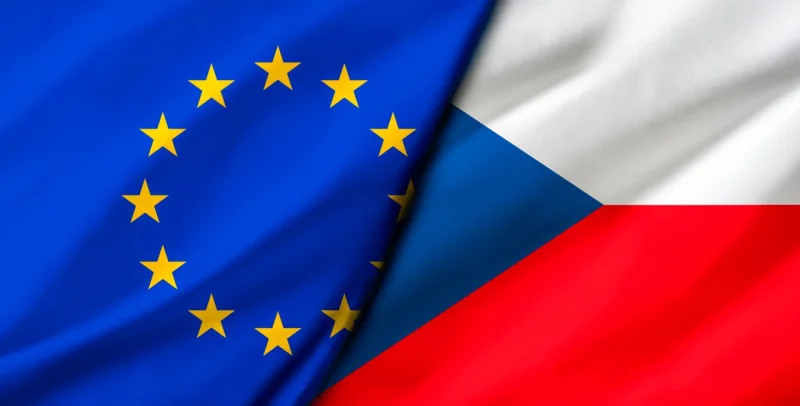
When Robert Schuman warned on May 9, 1950 that world peace could not be safeguarded without creative efforts equal to the dangers ahead, he was laying down the moral logic that would later pull Czechia into the European project. Twenty-two years after the country joined the European Union on May 1, 2004, that promise still defines the debate around membership — but so does doubt.
Czechia entered the bloc during the European Union’s largest enlargement wave since its creation, after a 2003 referendum in which more than three-quarters of voters backed membership. Just 55 percent of eligible voters turned out, but 3.5 million said yes and more than one million said no, a split that still echoes in a country that has spent years among Europe’s most Eurosceptic nations.
In the 1990s, more than 80 percent of Czechs were eager to join the European community. Jan Hartl, who watched that mood build, later said it was “a distant goal, a kind of symbol of our country belonging to the West” — more an idea than something concrete. The feeling was strong enough to carry the country into the EU, but not strong enough to settle the argument over what membership would mean once the flags and speeches faded.
That argument has only become more complicated. Today, just about one-third of citizens view the EU positively, and less than two-thirds say membership has benefited Czechia. At the same time, about 80 percent of the country’s exports now go to another EU country, a reminder that daily prosperity is tied to a system many voters still greet with suspicion.
The political divide was sharpened during Václav Klaus’s presidency from 2003 to 2013. Klaus repeatedly argued that EU integration threatened national sovereignty and democratic accountability, and those warnings helped fix European politics in the Czech mind as something distant, technical and foreign. Petr Weiss, a former European Parliament member, said the problem was not just public indifference. “European politics is still understood here as foreign,” he said. “Politicians do not explain it, do not pay attention to it, do not understand it. And if the political elite does not understand something, the public cannot understand it either.”
That suspicion deepened after the sovereign debt crisis and again during the 2015 migration crisis, both of which fed negative views of the EU in Czechia. On paper, the country is deeply embedded in the bloc. At the European Council level, Prime Minister Andrej Babis speaks for the Czech Republic. In Brussels, Permanent Representative Vladimír Bärtl handles the day-to-day diplomacy. Jozef Síkela serves as Czechia’s EU Commissioner for International Partnerships, and 21 Czech MEPs sit in the European Parliament. Yet the public mood remains far cooler than the country’s economic and political ties would suggest.
That is the unresolved fact of Czechia’s 22 years in the EU: the country helped build the club’s most ambitious expansion, voted to join it by a decisive margin, and still never fully made peace with what membership asks of it. The numbers point in one direction. The politics keep pulling in another.