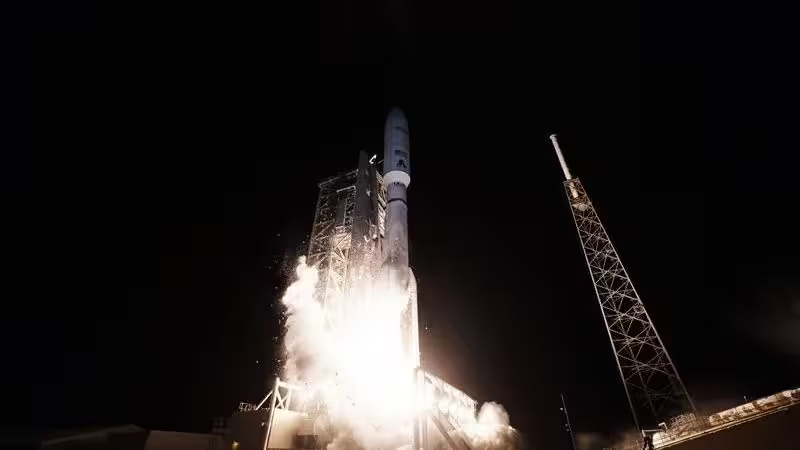
United Launch Alliance launched 29 Amazon internet satellites Monday night on an Atlas V rocket from Cape Canaveral Space Force Station, sending the spacecraft into low Earth orbit in a mission that tied the vehicle’s heaviest payload record. The rocket lifted off at 8:53 p.m. EDT on April 27 and completed 10 separate deployments about 21 minutes later, finishing 16 minutes after that.
ULA called the flight Amazon Leo 6, the sixth mission it has flown for Amazon Leo, the broadband network once known as Project Kuiper. The launch came two and a half weeks after Amazon Leo 5 on April 4, which also carried 29 satellites and set the Atlas V payload record at 18 tons.



The latest flight matters because Amazon Leo is moving from plan to buildup. If all goes as intended, the network will grow to more than 3,200 satellites, and more than 80 launches on a mix of rockets will be needed to finish the job. Monday’s mission was one more step in that effort, and it showed the Atlas V can keep carrying one of the program’s largest batches yet.
The pace is already visible in the launch tally. Before Monday night, there had been 10 Amazon Leo liftoffs in all: six on Atlas V, three on SpaceX’s Falcon 9 and one on Arianespace’s Ariane 6. The first four Atlas V missions sent 27 broadband satellites skyward, and the last two have each carried 29, matching the vehicle’s high-water mark for payload weight.
That also sets up the next test for the program. Another Amazon Leo mission is scheduled to launch early Wednesday morning, April 29, from French Guiana on Ariane 6. If it lifts off as planned, it will add to a deployment campaign that is no longer about proving the concept. It is about filling the sky, launch by launch.