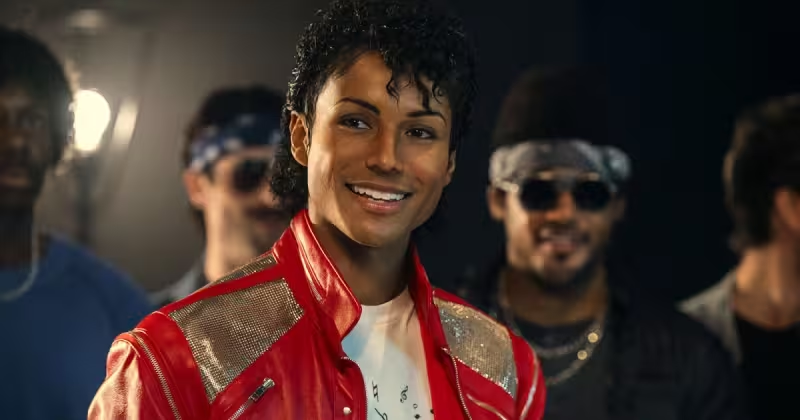
“Michael” is built like a victory lap and it never pretends otherwise. The Jackson estate-approved film follows Michael Jackson from his youth in Gary, Indiana, to the moment he proclaims his independence from his father in 1984, and then stops short of the harder story that came later.
That omission is the movie’s defining choice. It is utterly incurious about Jackson’s psychological development, personality and contradictions, even though his childhood performances drew Suzanne de Passe’s attention and his rise seemed to promise an escape from anti-Blackness and economic inequity in America. The film, penned by John Logan and directed by Antoine Fuqua, presents the rise without the damage, the triumph without the cost.
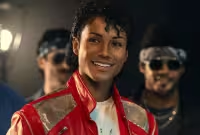
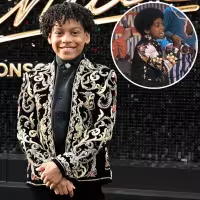
Jackson’s real life would not stay neatly inside that frame. In the years that followed, he married Elvis Presley’s daughter, dangled his infant from a hotel balcony, wore pajamas to court and became the target of the press nickname “Wacko Jacko.” Allegations of child sexual abuse surfaced in the 1990s, and the 2019 premiere of “Leaving Neverland” pushed the question of harm he may have done to children back into public view. After that film aired on HBO, Oprah Winfrey told Jackson’s accusers she believed them. For a biopic arriving now, the refusal to engage that history is not a side note. It is the movie.
The same refusal to look too hard at uncomfortable realities echoes well beyond Jackson’s estate. Jordan Neely, a homeless Michael Jackson impersonator, was in the middle of a mental health crisis aboard an MTA train on May 1, 2023, when Daniel Penny placed him in a chokehold and he died. A second-degree manslaughter case against Penny was dismissed after a jury deadlocked, and the same jury acquitted him of criminally negligent homicide. Andreessen Horowitz later hired Penny after the verdict, while Marc Andreessen said in a podcast interview that introspection is something he engages in “as little as possible” and added, “I find that people who dwell on the past get stuck in the past.”
That is what makes “Michael” more than a glossy portrait. It is a test of how much a culture can soften a legacy before it stops describing the person at all. The film answers that question plainly: quite a lot.