Caltech researchers have built an ultrasound tomography system that can image whole cross-sections of the body, and they tested it on five healthy volunteers who had their abdomens scanned for 10 seconds at a time. The paper describing the system was published April 24, 2026, in Nature Biomedical Engineering.
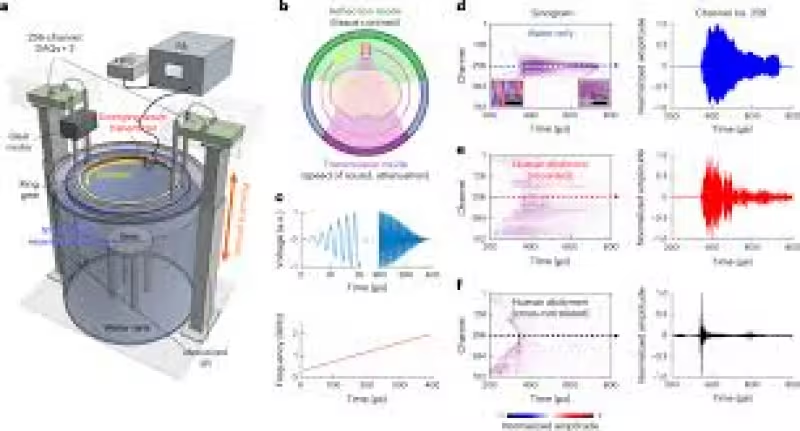
The setup uses a lab-made ring-like structure with 512 transducers around an immersion tank, with participants sitting in the water and their heads out. From that arrangement, the system can measure echoes, transmission signals and attenuation, and it can quantify the speed of sound to help distinguish between tissue types. In testing, it produced images similar to those made by MRI and other standard whole-body imaging modalities.
Lihong Wang said the system is operator independent, and that it offers a large field of view because it shows the entire cross-section without compressing tissue, which can distort imaging. He also said ultrasound is harmless to patients compared with techniques that use ionizing radiation, and noted that the team needed water between the patient and the transducers for efficient propagation.
That approach echoes an early 1950s ultrasound system that submerged patients in a tank of water, but cal tech researchers say this version goes much further. Conventional ultrasound uses a single transducer to send high-frequency sound pulses and build two-dimensional images, often with hydrogel on the skin to remove air gaps, while this system is designed to scan an organ from all sides and image deep in the body. The tradeoff is the water bath, which remains essential to the method.
Wang said the added measurements could improve the system’s clinical value. When tissue varies, he said, it can signal diseases such as chronic inflammation and cancer, and if a tumor causes tissue to solidify, the stiffness, echogenicity, speed of sound or attenuation can change. For now, the main question is how well those measurements map onto real disease in larger studies, after an early test that showed the technique can deliver whole-body cross-sections rather than the limited views conventional ultrasound provides.