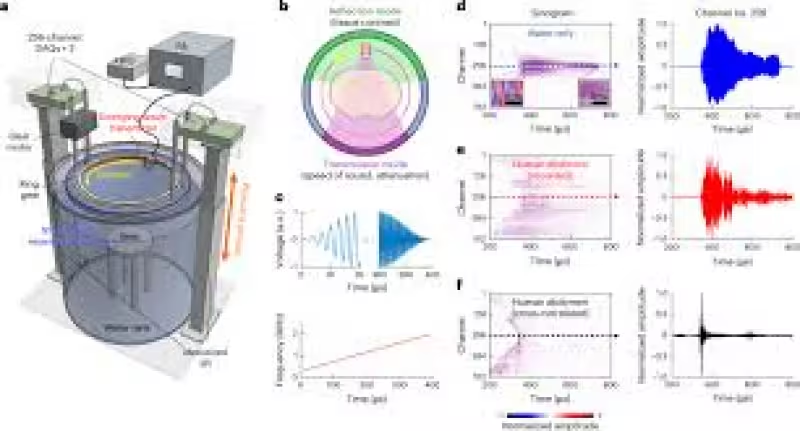
Caltech researchers have developed an ultrasound tomography system that can image whole cross-sections of the body, a step that could broaden how doctors look for disease without using ionizing radiation. The paper was published April 24, 2026, in Nature Biomedical Engineering and describes a setup that is operator independent, scans deep in the body and produces images similar to those made by MRI and other standard whole-body imaging methods.
Lihong Wang said the system offers a large field of view because it captures the entire cross-section and avoids compressing tissue, which can distort images. He also said ultrasound is entirely harmless to patients, a point that gives the technology an edge over techniques that rely on ionizing radiation.
The demonstration system placed participants in an immersion tank with their heads out of the water so ultrasound could travel efficiently. A lab-made ring-like structure around the tank held 512 transducers, which the team used to scan up and down the body and image different cross-sections. In five healthy volunteers, the researchers scanned the abdomen for 10 seconds at a time.
The work builds on a basic limitation of conventional ultrasound, which uses a transducer to send high-frequency sound into the body and measure returning echoes for two-dimensional images. Those scans are widely used to examine soft tissue and organs, measure blood flow and monitor fetal development, but they can be constrained by a limited field of view and by operator error. The new approach is designed to capture more of the body at once, while also measuring transmission signals, speed of sound and attenuation.
Wang said changes in tissue can point to disease, including chronic inflammation and cancer, and noted that a tumor can make tissue stiffer while changing its echogenicity, speed of sound or attenuation. That ability to quantify several physical properties at once is what gives the method potential clinical value. The system still depends on water contact between the body part and the transducers, echoing an early 1950s ultrasound setup in which patients were submerged in a tank of water.
The question now is not whether whole-cross-sectional ultrasound can work in people, but how far it can be pushed. If larger studies show the same deep-tissue detail and consistency seen in the five-volunteer demonstration, caltech's system could become a practical way to look for disease without radiation, compression or the narrow view that has long defined conventional ultrasound.