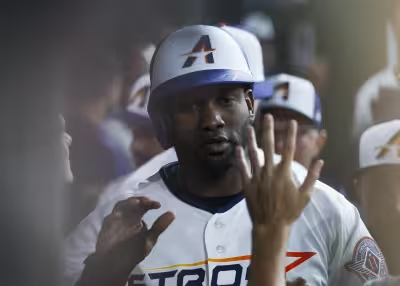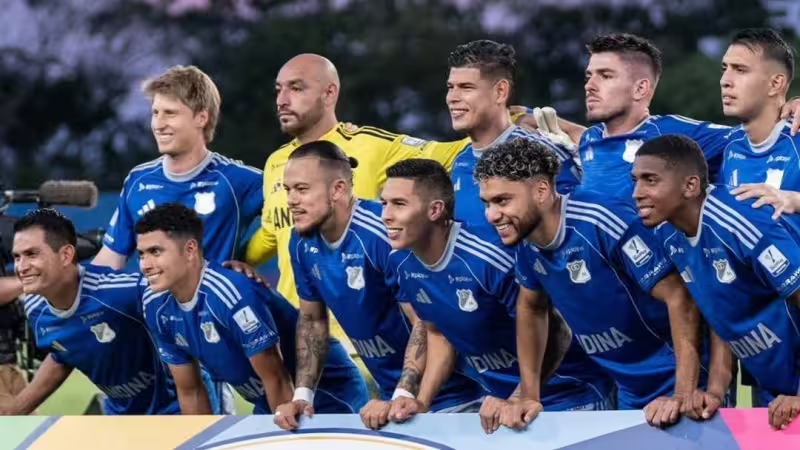
O'Higgins will face Millonarios in the Copa Sudamericana 2026 as the Chilean club prepares for its first meeting with the Colombian side and its fourth appearance in the tournament. The Rancagua team returns to the continental stage with a record that is brief but stubborn: one league title, one Super Cup and a history of arriving, for a while, where bigger budgets did not expect it to stay.
Founded on 7 April 1955 after a merger of América and O'Higgins Braden, O'Higgins became a Sociedad Anónima in 2005 after socios accepted the offer led by Ricardo Abumohor. Francisco Rajcevich was the club's first president. The team won its only Chilean league title in the Apertura 2013, then added the 2014 Chilean Super Cup by beating Deportes Iquique on penalties under Eduardo Berizzo. That remains its most recent official trophy.
The club's place in South American competition was built much earlier. O'Higgins first played the Copa Libertadores in 1979 and reached the semifinals in 1980, still its best international campaign. It has since appeared in the Libertadores five times — 1979, 1980, 1984, 2014 and 2026 — and is also set for a fourth Sudamericana run. The previous three ended early: against Cerro Porteño in 2012, Montevideo Wanderers on penalties in 2016, and Fuerza Amarilla of Ecuador in 2017.
This latest campaign comes after O'Higgins dropped into the Sudamericana from the Libertadores path. It eliminated Bahia of Brazil on penalties after a 2-2 aggregate tie, then fell to Deportes Tolima in phase 3 by a 1-2 aggregate score, winning 1-0 in Chile before losing 0-2 in Ibagué. The team now turns to Millonarios with the Monasterio celeste in Requínoa, in the Las Mercedes sector about 24 kilometers from Rancagua, as the base for a club that has spent decades trying to make limited success feel bigger than the numbers suggest.
For O'Higgins, the matchup is less about history with Millonarios than about proving that its rare peaks still matter. The club has won the Chilean league only once, but it has already shown it can surprise stronger names on the continent. The question now is whether that old pattern still holds when the next test arrives.