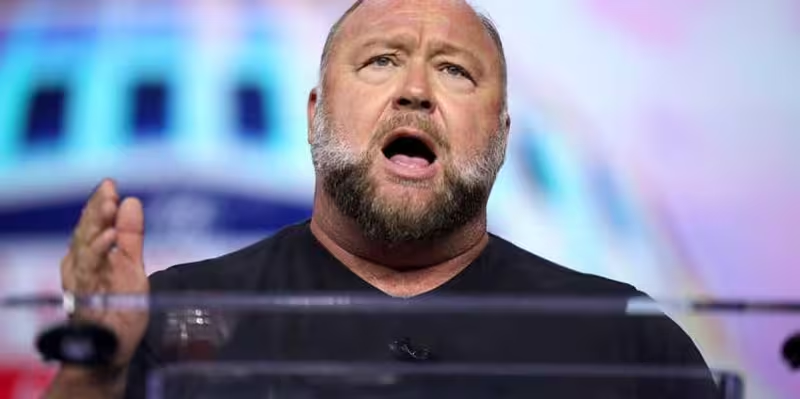
Josh Owens says he left Infowars carrying a story he could not have told while he was still inside it. The former video editor and field producer worked for Alex Jones for four years, from 2013 to 2017, and has now written a book, The Madness of Believing, about the world he entered and the one he had to leave behind.
Owens described that world last week as “constant chaos,” a place that pushed him from California radiation hunts after Fukushima to Ferguson, Missouri, for Black Lives Matter protests, to Nevada to retrieve Cliven Bundy’s cattle. He also said the job took him to dinner with Nation of Islam leader Louis Farrakhan and led him to fabricate a video showing an Islamic State operative sneaking into the United States. “Jones’s instinctual desire to distance himself from the mainstream led us to unusual and sometimes dark places,” Owens said.
His account lands now because Infowars is once again in public view. This week, Donald Trump gave Tucker Carlson, Marjorie Taylor Greene, Megyn Kelly, Candace Owens and Jones a shoutout, prompting Jones to accuse Trump of “committing political suicide on purpose” and say America “is now under the control of a foreign government.” The latest exchange gives fresh visibility to a network that has remained stubbornly alive long after the damage around it became impossible to ignore.


That damage is tied most directly to Jones’s lie that the 2012 Sandy Hook school shooting was a hoax meant to force Americans to accept gun control. The shooting left 20 children and six educators dead, and Jones now faces a defamation judgment of $1.5 billion in damages. A ruling demanded the sale of Infowars, and the satirical news site the Onion bought it out of bankruptcy court in 2024 before a later bankruptcy decision rejected the winning bid. The result is a company still in limbo while Jones continues to broadcast.
Owens, who said he was deradicalized with the help of other people, presents his book as an inside view of how that machine worked and what it did to the people in it. “I entered that world as a person I now don’t recognize at all,” he said. “I was a firm believer in a lot of the things and contributed to it in my own way.”
The question now is not whether Infowars reshaped the people who worked there. Owens says it did. The question is how long a brand built on falsehoods, spectacle and grievance can keep drawing attention even after the court fights, the bankruptcy fight and the Sandy Hook judgment have left it damaged but still on air.