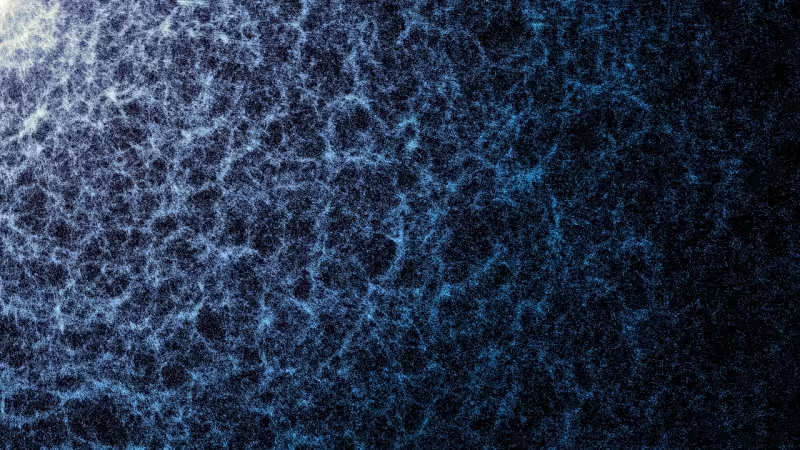
On a night near the Little Dipper, a camera mounted on the U.S. National Science Foundation Nicholas U. Mayall 4-meter telescope finished taking the last planned look for a project that has now mapped more than 47 million galaxies and quasars. By sunrise, scientists behind DESI were marking the completion of the largest high-resolution 3D map of the Universe to date.
The five-year survey finished ahead of schedule, and DESI will keep observing into 2028. The effort uses 5000 fiber-optic eyes to collect light roughly every 20 minutes, building a map researchers use to trace dark energy’s influence over 11 billion years of cosmic history.
Stephanie Juneau, one of the collaborators, said it is impossible to capture everything that went into making DESI such a successful experiment, pointing to the instrument builders, software engineers, technicians, observatory staff, scientists and many early-career researchers who made it work. She said the team was doing the project for all humanity, to better understand the Universe and its eventual fate.
DESI is managed by the U.S. Department of Energy’s Lawrence Berkeley National Laboratory and was constructed and operated with funding from the DOE Office of Science. More than 900 researchers at over 70 institutions, including 300 PhD students, have helped build and analyze the survey, which sits on one of the most extensive efforts to study the cosmos ever conducted.
The new completion matters because DESI’s first three years of data produced surprising hints that dark energy might be evolving over time rather than staying fixed. Dark energy is described in the survey as the fundamental ingredient making up about 70% of the Universe and driving its accelerating expansion. The full five years of data should give researchers far more information to test whether that early hint disappears or grows.
Juneau said she was sitting on the edge of her seat as the team analyzes the new map to see whether those hints are confirmed, and said she is also intrigued by the other discoveries waiting in the dataset. For now, the map is finished. The question is whether it will redraw the rules of cosmic expansion.