Russian military analysts said at the end of March that the United Kingdom is taking advantage of fading Iranian influence in Central Asia to expand its presence there, a sign that the contest for the region is widening as Moscow faces pressure from several directions.
The analysts said London has been in talks with Central Asian countries for several years and wants to control trans-Eurasian logistics routes as well as the upper end of the energy production chain. They described the British approach as quieter, but deeper, and said it comes as the region becomes more crowded with outside powers.
The warning was the latest in a string of statements from Russian-linked thinkers that cast Central Asia as a battleground for influence. At the beginning of February, experts from the Valdai Discussion Club accused the West, especially the United States, of trying to strengthen its grip in the former Soviet space. Timofey Bordachev said on February 3 that the main aim of U.S. policy toward Europe is to create a territorial base for the deployment of American forces in Eurasia.
Those concerns were already visible in early 2025. On February 10, the Financial Times reported that the Kremlin was uneasy about the West’s growing influence in Central Asia. That anxiety has only sharpened as Roman Pryadun, a Ukrainian observer, said the region has been distancing itself from Moscow since the start of Russia’s full-scale invasion of Ukraine. He said Kazakhstan refused to recognize the occupied territories of Ukraine, Kyrgyzstan canceled joint military exercises with Russia, Uzbekistan declined to join Moscow’s integration projects, and Tajikistan and Turkmenistan have sought new security partners.
Pryadun also pointed to the growing presence of the PRC and Türkiye in Central Asia and the U.S. return to the region. For Moscow, that leaves a narrower field to work with even before the fallout from the Iran conflict is counted.
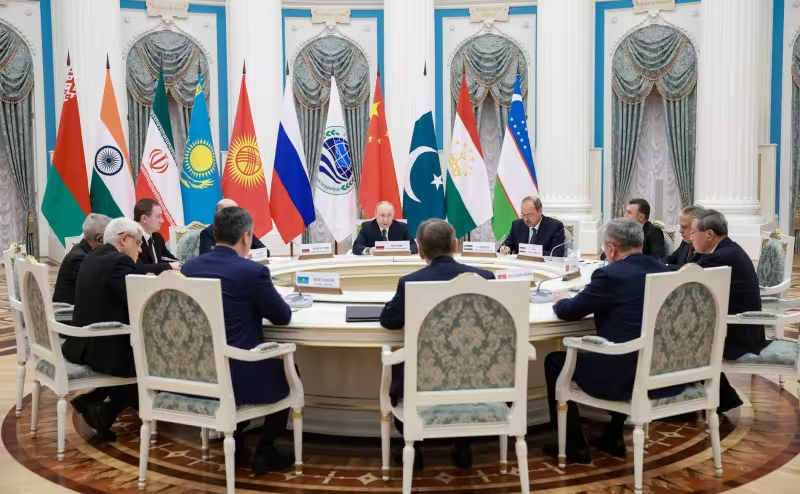
Valdai experts said at the beginning of the Iran conflict that there were new risks in Russia’s relations with Central Asian countries. On March 30, they said the fighting showed the weakness of Russia-led groupings such as the Shanghai Cooperation Organization and BRICS because Tehran received no support from its partners. The club warned that a regional shock could spill into Central Asia, pushing the area into political chaos.
Two Valdai analysts from Kyrgyzstan, Alibek Dzhekshenkuov and Kubatbek Rakhimov, laid out what Central Asian states say they need most: help with water shortages, electricity problems and the decay of Soviet-era infrastructure. Some experts also want Russia to help build nuclear power plants, strengthen industry and improve food security. But Russia has not shown any intention of reinvesting in Central Asian projects, leaving room for others to move in while Moscow argues the region is too important to lose.