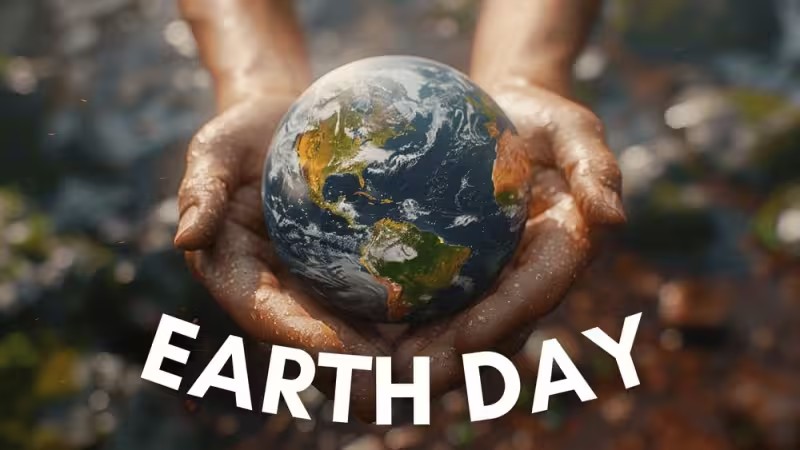
Earth Day returns on Tuesday, April 22, marking its 56th anniversary. In a year when the question of when is earth day still gets asked every spring, the answer is simple: April 22, with observances this year ranging from church events in Wolfeboro to free seedlings in Meredith.
At the First Congressional Church, UCC, of Wolfeboro, Reverend Kendra Ford will present “350nh and No Coal No Gas” at the 10 a.m. service on April 19, followed by an EcoFair from 11:15 a.m. to 12:30 p.m. Moulton Farm of Meredith is also marking Earth Day on April 22 by giving away free flowering seedlings, a small but visible sign that the day still reaches people through local action even as broader participation has faded.
Earth Day began as a national mobilization in 1970, when 20 million Americans — about 10 percent of the US population — took part in demonstrations protesting the damage caused by 150 years of industrial development. Senator Gaylord Nelson of Wisconsin pushed the idea after a massive oil spill off Santa Barbara, California, in 1969, proposing a campus teach-in on pollution and the environment. He persuaded Denis Hayes to organize the events and brought in Congressman Pete McCloskey to help spread the message, with April 22 chosen because it fell between Spring Break and final exams.



Read Also: Lionel Richie Reflects on Jesus Is Love After American Idol
Some people trace the movement back even farther, to Rachel Carson’s 1962 book Silent Spring. Carson, a marine biologist and writer with the US Fish and Wildlife Service, used the book to warn how industrialization had poisoned air, water and living things. Silent Spring sold more than 500,000 copies in 24 countries and exposed how the widespread use of DDT and other long-lasting weed-control chemicals was harming wildlife, habitat and human life. “There would be no peace for me,” she wrote, “if I kept silent.”
That history gives the day its weight, but it also highlights the gap between the scale of the original movement and the way Earth Day is often observed now. Participation has fallen in recent years, and the day is increasingly marked by individual efforts rather than the mass demonstrations that first made it a force. This year’s church service and farm giveaway show how the observance has narrowed without disappearing, keeping the date alive one local event at a time.
What happens next is modest but clear: communities will keep using April 22 as a marker for environmental action, whether through worship, education or small public gestures. Earth Day remains fixed on the calendar, but its meaning is still being defined by the people who show up for it.