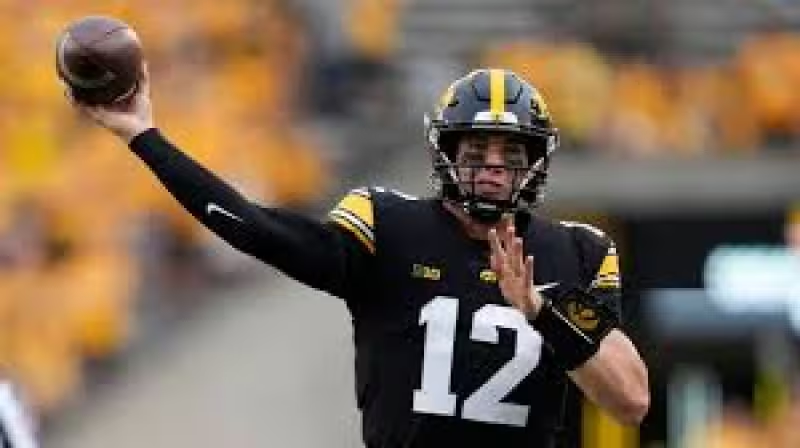
The NCAA said Tuesday that tampering violations occurred in the Iowa football program after Kirk Ferentz and assistant coach Jon Budmayr had impermissible contacts with a student-athlete who was still enrolled at another school and had not yet entered the NCAA Transfer Portal.
Budmayr’s November 2022 communications were extensive. He took part in 13 phone calls with the athlete and or his father, sent two text messages and arranged for the player to speak by phone with Ferentz, who told him he would have a home at Iowa. The athlete entered the portal after those contacts and transferred to Iowa a few days later.
The case landed at a consequential moment for iowa hawkeyes football because the NCAA said the player competed in the 2023 season before being reinstated. Under current NCAA rules, when a student-athlete transfers to a school that engaged in tampering, the athlete is ineligible until reinstatement. The panel classified the violations as Level II-Mitigated for all parties and said Ferentz and Budmayr resolved their cases through negotiated resolutions and served suspensions.


Ferentz publicly accepted accountability for the violations, and the panel said the lapse in judgment did not call into question his integrity or decades of running a compliant football program. It also said, “When respected individuals identify their mistakes and take responsibility for them, it sets the standard for appropriate behavior within their programs, universities and, more importantly, across the broader industry,” and added that it appreciated “the actions taken by Iowa and Ferentz to publicly address his and his staff member's conduct.”
The sharpest disagreement in the case was over the vacation of records penalty. Iowa did not agree with applying it, but the Committee on Infractions said the penalty is appropriate under the current infractions process. The panel noted that NCAA members have consistently treated vacation of records as the way to address conduct at the time it occurred, and it said that since 2018 Division I schools have considered student-athletes who were tampered with and later competed for the tampering school to have played while ineligible.
The decision closes one chapter for Ferentz and Iowa, but it also sets up the practical consequence the school fought hardest to avoid: a records penalty tied to competition that happened before the violation was sorted out. For Iowa, the punishment is not only about what Budmayr and Ferentz said in November 2022, but about how the NCAA now says those words changed the status of the player who followed them to Iowa a few days later.