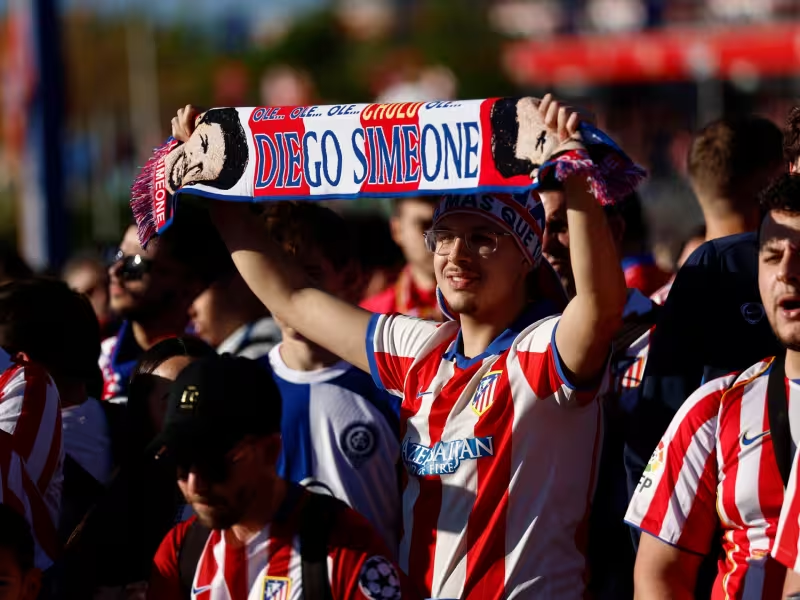
Barcelona were preparing to try to overturn a 2-0 first-leg deficit in their Ucl quarter-final, while Atletico Madrid arrived at Sevilla on Tuesday with little margin for another slip after Diego Simeone rotated heavily and still lost 2-1. The night already carried the feel of a crossroads for both Spanish clubs, with Liverpool also facing the defending champions at Anfield while protecting a 2-0 lead from the first leg.
Atletico’s defeat came after Akor Adams scored from the penalty spot for Sevilla, Javier Bonar equalised before the interval and Nemanja Gudelj restored the hosts’ lead before halftime. The result left Atletico fourth in the league standings on 57 points, four behind third-placed Villarreal, and it also underlined how costly any rotation can be when the season is still live in several directions.
Barcelona’s own challenge looked very different. The club had already reached the quarter-finals with an 8-3 aggregate win over Newcastle United, after beating them 7-2 at Camp Nou in the second leg with five different players on the scoresheet. That kind of margin gave them breathing room, but not complacency, as the first-leg deficit meant they still had to play the chase game on a night when one bad spell could turn the tie back against them.



The contrast with Atletico’s recent Champions League history is stark. Simeone’s side advanced 7-5 on aggregate against Tottenham Hotspur earlier in the competition, but only after losing the second leg 3-2 in North London, despite scoring four times in the opening 22 minutes of the first leg. Julian Alvarez and David Hancko both scored in that second leg, yet the wider pattern was hard to miss: Atletico can overwhelm teams, and they can also let them back in.
That is why this stage matters so much for Atletico. The club have never won the Champions League, and the scars of 2014 and 2016 still hang over them after they reached the final in both seasons and lost to Real Madrid each time. A side that sits fourth in the league and has spent years circling the trophy cannot afford the kind of uneven night it produced in Seville if it wants to look like a genuine contender again.
Barcelona, meanwhile, were set to line up in a 4-2-3-1, with Olmo, Lopez and Yamal behind the central forward, Gavi and Pedri holding in midfield, Cancelo and Kounde back at full back, and Martin and Garcia in the heart of defence. On paper, it was a shape built for control and speed, the sort of setup that can turn a European tie in one burst if the first goal comes early. For both Spanish clubs, the margin for error was already gone.