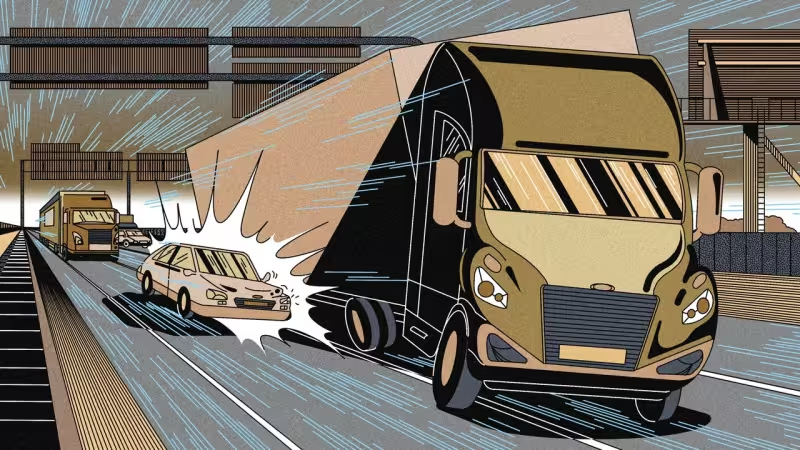
Large trucks kill more than 5,000 people a year in America, and the deadliest crashes usually fall on the people inside smaller cars. On any given day, roughly three million tractor-trailers are moving goods along U.S. highways, where a fully loaded eighteen-wheeler can weigh 80,000 pounds and keep rolling far beyond where drivers expect.
That scale helps explain why a big rig traveling at 65 miles per hour can cover the length of two football fields before it comes to a stop, even if the driver hits the brakes hard. The result is often catastrophic when a car rear-ends a trailer, producing an underride crash in which the lower half of the vehicle slides beneath the trailer while the roof and windshield are torn apart or crushed.
The danger is not theoretical. In 1967, Jayne Mansfield died when a Buick she was riding in crashed into a tractor-trailer, and the rear-impact guards that came to be known as Mansfield bars later became standard on the backs of trucks. But side underride remains a separate threat, and in most of Europe cargo trailers are fitted with barriers along the sides to stop cars from sliding underneath laterally. In the United States, the trucking industry has resisted adding those barriers, citing cost.
The consequences have been visible in recent crashes. In Oklahoma in 2009, a tractor-trailer failed to slow for traffic and crushed a Hyundai Sonata and a Kia Spectra, killing ten people. In 2023, Danny Glen Tiner was driving an eighteen-wheeler at 68 miles an hour near Chandler, Arizona, when he became distracted by a TikTok video on his phone and plowed into stopped traffic, killing five people. Tiner pleaded guilty to negligent homicide and was sentenced to 22 years in prison.
That is why a car wreck lawyer handling a truck case looks past the wreckage and toward the rules around it. Federal law limits truckers to 11 hours a day on their routes, a 2003 standard meant to keep drivers alert, but large-truck crashes still happen about half a million times a year and tend to come on weekdays, often at night. The pattern is the point: the machines are enormous, the exposure is constant, and the people most likely to die are the ones in the smaller vehicle.