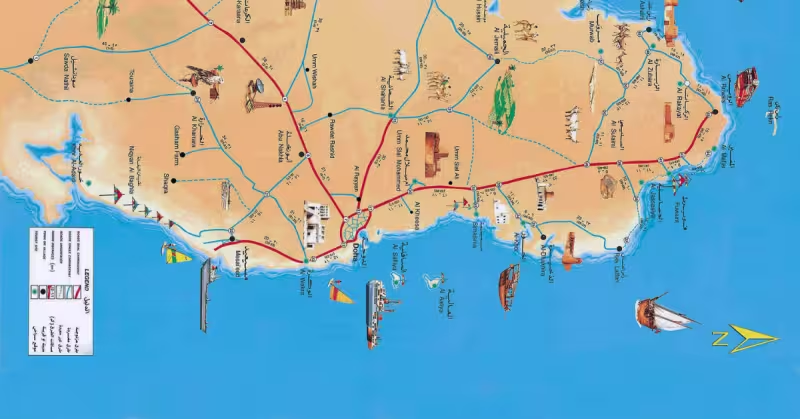
Qatar’s Ministry of Transport said on April 12 that maritime navigation has been fully restored for all vessel types in the country’s territorial waters, allowing operations between 6 a.m. and 6 p.m. daily under the new framework. Licensed fishing vessels may operate around the clock.
The announcement was posted directly on X and came with a safety advisory from Qatar’s Interior Ministry telling operators to make sure navigation systems and life-saving equipment are fully functional before departure. The move does not directly reopen the Strait of Hormuz, which remains under Iranian military control, but it marks the first clear easing in over six weeks of effectively closed Qatari maritime traffic.
For Qatar, the timing matters because the country is responsible for about 20 per cent of global LNG supply through Ras Laffan, the world’s largest LNG export facility. No loaded Qatari LNG tanker has successfully transited the Strait of Hormuz since February 28, and an April 6 attempt by the Al Daayen and Rasheeda did not complete a transit. Iran’s strikes on Ras Laffan infrastructure in early March took an estimated 17 per cent of export capacity offline.
The pressure has not stopped at Qatar’s shoreline. India’s Petronet LNG receives about 7.5 million tonnes of Qatari LNG a year under long-term contracts, while India’s gas distribution network has been imposing 10-20 per cent consumption cuts on industrial gas users since the crisis began. India’s LPG import requirement for FY 2026-27 has also been projected at 20.82 million tonnes, underscoring how far the disruption has spread beyond one export terminal.
The restoration inside Qatari waters is real, but it is not the same as a clean reopening of the passage that matters most to the country’s energy trade. Until traffic through the Strait of Hormuz is secured, the recovery announced in Doha will remain partial, and every cargo will still be moving through a chokepoint that has already halted Qatari LNG flows for weeks.