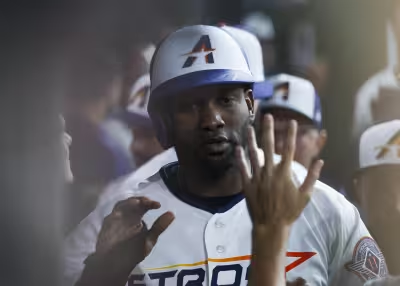
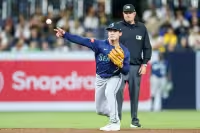
Josh Naylor’s first weeks in a Seattle Mariners uniform have gone badly enough to make the five-year, $92.5 million deal look far too expensive for the moment. He is hitting.102/.197/.102 with a.299 OPS and a minus-5 wRC+, a line that has him in the bottom tier of the sport and third-worst in baseball by that measure.
The numbers get worse when the lens narrows. Naylor has no home runs and no doubles so far in 2026, leaving him with a.000 ISO that ties for the worst in MLB. His.299 OPS and minus-0.6 fWAR trail only Marcell Ozuna, and his expected slugging percentage of.338,.138 wOBA,.273 xwOBA and.225 expected batting average show a hitter who has produced almost nothing and has also been denied even the shallowest power.
That is why the start matters now. Seattle made Naylor one of its first major winter signings and counted on him to be an important part of the lineup after he hit.295 in 2025 and.308 in 2023, seasons that fit a broader résumé built around three 20-plus home run years. The promise of that track record is what made the contract make sense, and it is also what makes this opening slump feel so jarring.
Read Also: Marcell Ozuna’s quiet exit from Atlanta ends with Pirates deal and .756 OPS
There is still a gap between what Naylor has done and what the underlying numbers say he should be doing. His expected metrics point to a hitter who has been unlucky rather than truly broken, which is why the current damage is more likely a blip than a permanent decline. Nolan Arenado’s own rough start,.180/.192/.200 with a.392 OPS and a 7 wRC+, shows how even proven bats can land in the same early-season hole, though his 25.0 K% and 1.9 BB% tell a different version of the struggle.
Read Also: Konnor Griffin Contract: Pirates wait on Ozuna after slow start
For Seattle, the issue is not whether Naylor can still hit. It is how long the Mariners can wait for the production that justified the check they wrote in the winter before 2026. If the contact quality keeps pointing up while the stat line stays empty, the only question that will matter is when the breakout arrives, because the club did not spend $92.5 million for a cold month.