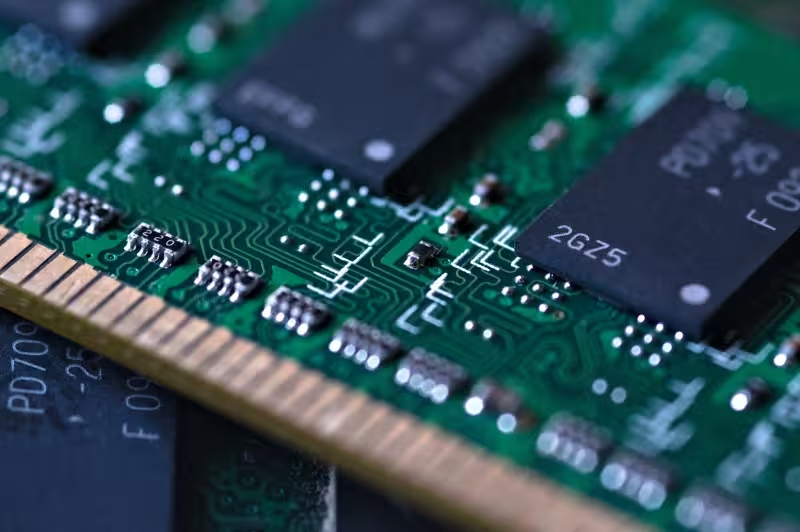
Micron’s stock has swung hard over the past year, with the Nasdaq-listed chipmaker running up sharply, tumbling last month and now rebounding back toward its highs. The move has put a fresh spotlight on the mu stock price just as investors weigh whether the memory business is entering a lasting upcycle or merely another turn in a familiar cycle.
That debate matters because Micron gets about 80% of its revenue from DRAM and about 20% from NAND, two markets now squeezed by demand tied to the AI infrastructure buildout. DRAM prices are being buoyed by demand for high bandwidth memory, or HBM, a specialized form of DRAM packaged with graphics processing units and other AI chips. HBM requires upwards of three times the wafer capacity of standard DRAM, and Micron, SK Hynix and Samsung are directing most of their resources to meet that demand. The result is tighter supply and higher prices across the memory chain, while NAND is seeing strong demand from enterprise solid state drives used to store AI model training data.
Micron’s latest rebound comes as the market tries to price in a business that can look very different depending on the cycle. Memory-chip companies are notorious for boom-and-bust periods, and past stretches of undersupply have often given way to overcapacity and falling prices once new production flooded in. This time, though, the setup is different in one important way: the industry is shifting away from short quarterly HBM deals and moving toward three- to five-year deals, a sign that suppliers and customers are trying to lock in capacity for longer. That shift suggests the AI-driven demand wave is being treated less like a passing spike and more like a structural change.



Read Also: Jim Cramer says data center memory stocks are driving a narrow market rally
Even so, there is no quick relief in sight. Neither the DRAM nor NAND market is expected to see much easing until late 2027 at the earliest, when some new production capacity is expected to start coming online. Until then, supply constraints could keep pricing firm and leave Micron and its Korean rivals fighting for the most attractive parts of the market. For investors, the valuation has become part of the argument too: Micron is trading at a forward P/E of just 4 times fiscal 2027 analyst estimates, a level that reflects both the promise of the AI buildout and the old fear that memory booms do not last forever.
Read Also: Nvda Stock lift sees Micron’s HBM4 breakthrough turn into a sales victory
For now, the company sits at the center of a bull-versus-bear case that is unusually easy to frame and hard to settle. If AI keeps pulling on memory demand the way it is now, Micron’s rebound could still have room to run. If the old cycle reasserts itself first, the recent recovery in the mu stock price may prove to be only another sharp turn in a business that has seen plenty of them before.