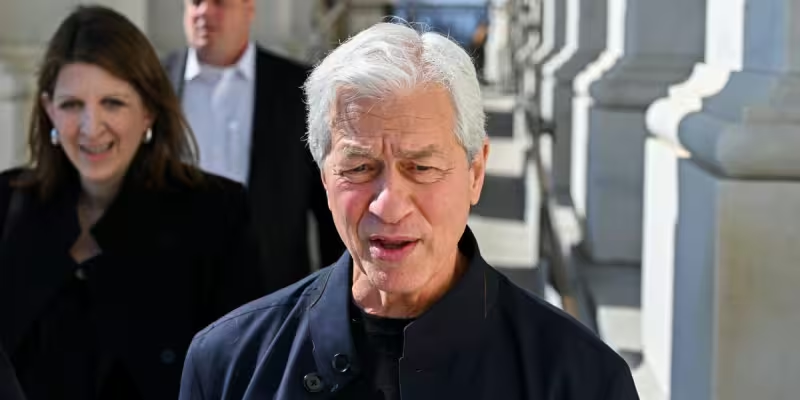
JPMorgan Chase Chief Executive Jamie Dimon said the United States has waited too long to confront its debt crisis, warning that the cost of delay could show up in volatile markets, higher rates and a loss of buyer appetite for Treasuries. The federal debt now stands at more than $39 trillion, and interest paid on it is already above $1 trillion a year.
On NPR’s Newsmakers podcast, Dimon said the best way to handle the problem is to acknowledge it and work on it, adding that the Simpson-Bowles Commission would have been “a home run for all of Americans” and could have resolved some of the country’s fiscal problems. The bipartisan National Commission on Fiscal Responsibility and Reform was created under President Obama and recommended cutting discretionary spending, reforming tax law and reshaping health care spending, but none of its conclusions were ever formally turned into law.

Dimon’s warning lands as the federal budget remains heavily weighted toward mandatory programs. In 2025, Medicare, Medicaid and Social Security accounted for $4.2 trillion of the government’s $7 trillion in spending, according to the Congressional Budget Office’s most recent full-year calculations. That leaves relatively little room to absorb rising borrowing costs, a pressure point that has pushed the debt question back into public view even as both parties have struggled to act.
The financial industry executive said the problem could still take years to erupt, telling listeners he did not know whether it would become a real problem in six months or six years. He argued that lawmakers should move sooner rather than later, warning that if the country waits, it will end up in “crisis management,” which he said the nation can get through but should avoid. Dimon also said neither Democrats nor Republicans have focused on the issue for a while and that the country has lacked the will to deal with it.
That political hesitation is part of what keeps the debt crisis unresolved. The Committee for a Responsible Federal Budget has long backed a federal unified budget deficit at or below 3% of GDP, but the current deficit is around 6% of GDP. Rep. Bill Huizenga, a Republican from Michigan, and Rep. Scott Peters, a Democrat from California, both support the 3% target. The question now is whether Washington will finally act before borrowing costs or market pressure force the issue.