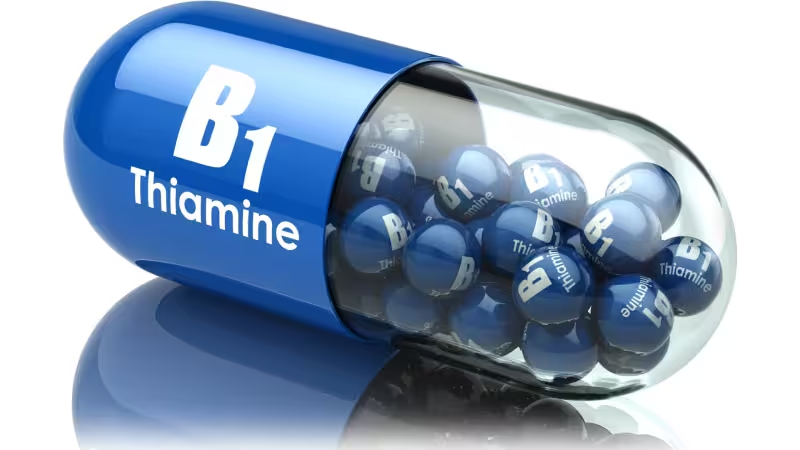
Chemists have stabilized an extremely reactive molecule in water, a result that confirms a 67-year-old theory about vitamin B1 and settles a question that has lingered since 1958. The team isolated the carbene, sealed it in a tube and found that it stayed intact for months.
The work, published in Science Advances, gives fresh support to Ronald Breslow’s proposal that vitamin B1 can transform into a carbene to drive key biochemical reactions. Vincent Lavallo said, "This is the first time anyone has been able to observe a stable carbene in water," and added, "People thought this was a crazy idea. But it turns out, Breslow was right."
To reach that result, the researchers used nuclear magnetic resonance spectroscopy and x-ray crystallography to analyze the molecule. Carbenes are usually highly unstable, with six valence electrons rather than the eight that make many molecules more comfortable, and they typically react almost immediately with whatever is around them. That is part of what made the water result so striking: scientists had not been able to directly observe the proposed vitamin B1 carbene-like structure in water before this study.
The chemistry matters beyond one stubborn molecule. Carbenes are already widely used as ligands in metal-based catalysts, and many chemical production processes still depend on toxic organic solvents. Raviprolu, who completed the research as a graduate student at UC Riverside and is now a postdoctoral researcher at UCLA, said, "We were making these reactive molecules to explore their chemistry, not chasing a historical theory," and, "But it turns out our work ended up confirming exactly what Breslow proposed all those years ago."
He also said, "Water is the ideal solvent -- it's abundant, non-toxic, and environmentally friendly," and, "If we can get these powerful catalysts to work in water, that's a big step toward greener chemistry." That is the larger significance of the finding: if reactive catalysts can be made to function in water, the work could help make pharmaceuticals, fuels and other materials more cleanly. For Breslow’s idea, long treated as chemistry folklore, the answer is now plain.