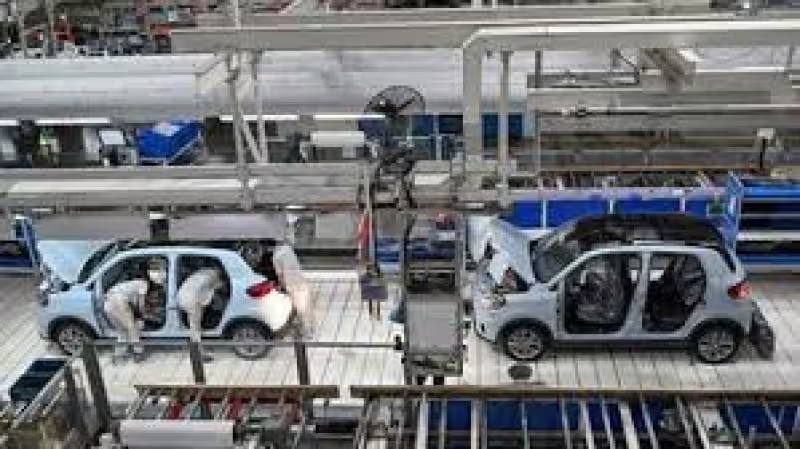
Stellantis is considering letting its joint-venture partner Leapmotor use its idled Brampton, Ontario plant to build electric vehicles, a move that would keep the site active but not as a traditional auto assembly line. CBC reported the possibility late last week, and the idea drew sharp pushback from Ontario Premier Doug Ford, who said the province was “dead against this.”
The proposal would not turn Brampton into a full manufacturing plant. Instead, it would be a Complete Knock-Down facility, or CKD plant, taking unassembled parts from China and assembling, welding and painting them into finished vehicles. Flavio Volpe compared that model to an “IKEA furniture kit,” a shorthand for how the process works and why it unsettles labor advocates.
The concern is not just symbolic. CKD production generally requires far less local employment than a proper plant, probably about a quarter of the workforce on a per-car basis, and some such plants can operate with as few as 150 to 200 workers. Most are built for low production runs, sometimes only 8,000 to 10,000 units, a scale that looks very different from the Brampton operation that once employed about 3,000 Canadians in the plant itself and supported as many as 8,000 more jobs among suppliers around the area.
That is why Lana Payne said she had “serious concerns.” The Unifor leader has spent months pressing for a future that preserves more than a warehouse-style version of auto work, and her warning reflects a basic fear that the site could stay open while shedding much of the economic footprint that made it matter to the city in the first place. Stellantis owns 21% of Leapmotor, giving it a direct stake in any decision to shift work into the Ontario plant.
There is also a wider industry context behind the discussion. Stellantis recently recorded a 23.5-billion-euro write-off as it restructures its manufacturing and electrification plans, a sign of how aggressively it is reshaping its global footprint. Stephen Beatty said there was little chance of Brampton reopening for traditional manufacturing, linking that view to Trump tariffs and what he described as America’s gutting of environmental standards. He said the market for the vehicles that would have been built there had effectively been terminated.
The comparison to Brampton also reaches far beyond Canada. BMW’s Rosslyn plant in South Africa originally hand-assembled only a few 3 Series sedans a year, yet it produced 79,000 units last year. Volkswagen’s Beetle followed a similar path in knock-down plants around the world, and fully two million original Beetles were built that way, nearly 10% of the model’s lifetime production. The lesson is that CKD plants can grow into major operations when the market is right, but they usually begin as a much thinner bet on jobs and local content.
For Brampton, that leaves the same hard calculation now facing workers, suppliers and provincial officials: whether a CKD line is a bridge back into auto production or a smaller substitute for the factory the city once knew. The fight is no longer over whether the plant can be used. It is over what kind of work would actually come back if it is.