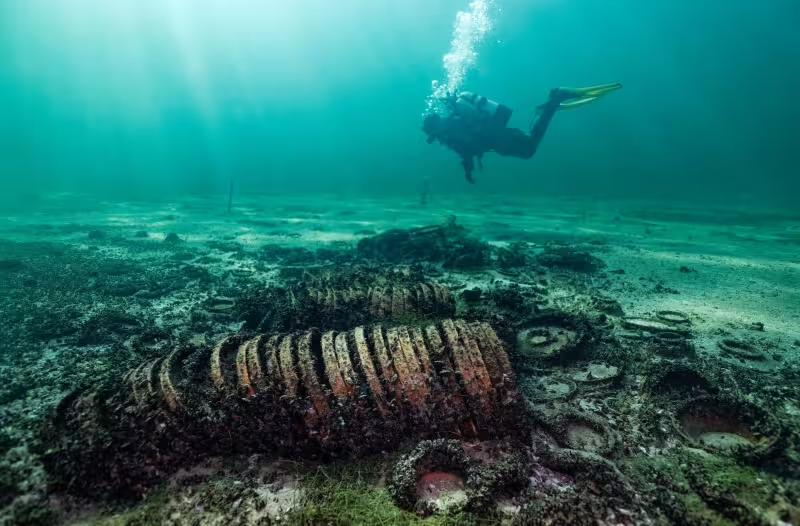
Archaeologists in northwest Switzerland have finished the underwater phase of work on an ancient Roman shipwreck in Lake Neuchâtel, recovering 1,200 artifacts from the lakebed after first spotting the site in November 2024. The vessel, believed to have crossed the 84-square-mile lake roughly 2,000 years ago, scattered its cargo for reasons that remain unknown.
Divers pulled up ceramic plates, platters and goblets that appear to have been made on the Swiss Plateau, along with fragments of amphorae likely used to carry olive oil and wine. They also recovered two swords, including one still sheathed in its scabbard, metal tools, pieces of harnesses, parts of horse-drawn chariots, a pickax, a belt buckle and a wicker basket.
The finds came from Lake Neuchâtel at the base of the Jura Mountains, near La Tène, one of the most important archaeological areas on the lake shore. Researchers say the ship may have been a civilian merchant vessel traveling with a military escort and carrying equipment for Roman soldiers stationed at Vindonissa, along the Aare River, between 16 and 45 C.E.
That unit was part of the 13th Legion, sent to Vindonissa, now the town of Windisch, to stop Germanic tribes from pushing south onto the Helvetian plateau and taking control of Alpine passes. The team said the cargo may have been damaged or destroyed by erosion, boat anchors, vandals or looters, which is why the most vulnerable pieces were brought up as a precaution.
Octopus Foundation researchers said the loss must have been immense at the time, but that the accidental shipwreck now offers archaeologists and historians a rare chance to better understand the world of the Helvetii inside the Roman Empire. Julien Pfyffer said the site is producing brand-new objects that could become a reference for this period, and the next step is study and conservation, with some items possibly headed for the Laténium archaeology museum. Researchers have still not found the ship itself.