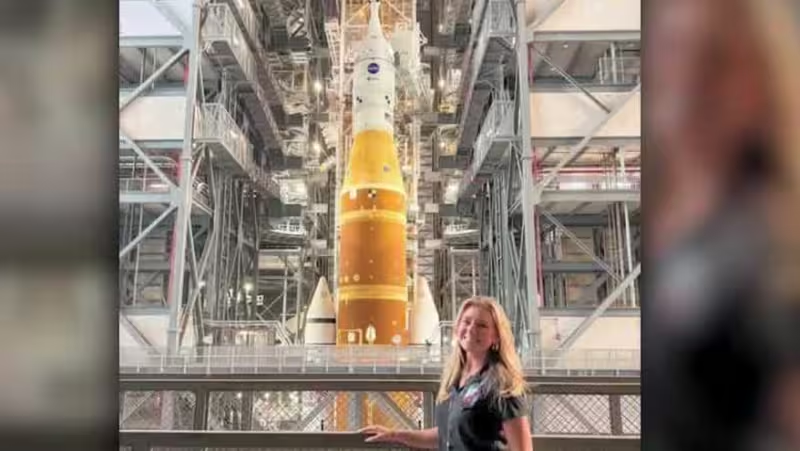
Four astronauts this week broke the record for the furthest distance humans have traveled from Earth, reaching more than 252,000 miles as Artemis II pushed deeper into space than any crewed mission before it. The work that guided them came from NASA’s Mission Control Center at the Johnson Space Center in Houston, where Keri Nelson leads the group that directs human spaceflight missions.
Nelson, who earned a mechanical engineering degree from the University of Texas at Austin in 1998 and was named NASA’s chief flight director in 2023, now manages 31 active flight directors and flight directors-in-training. She oversees human spaceflight missions including Artemis, placing her at the center of the operations that make questions like where is mission control for Artemis 2 easy to answer: it is in Houston, inside the agency’s Johnson Space Center.
The mission has also drawn on a deep bench of Texas graduates who have spent years inside the agency’s most demanding programs. Lee Frieling, who earned an aerospace engineering degree from the University of Texas at Austin in 1996, leads the ascent flight control team and was an Artemis I flight director. He supported more than 20 shuttle missions as a flight controller and oversaw the crew’s climb to space from launch until Orion separated from the Interim Cryogenic Propulsion Stage.
That same pattern runs through other parts of the Artemis II effort. Curtis Korsmeyer, who earned a master’s degree in aerospace engineering from Texas in 1988, is the deputy center director of NASA’s Ames Research Center and is helping analyze the Orion spacecraft’s heat shield on return to Earth while also working with the Artemis II science team on high-resolution images of the Moon. Bryan Brazzel, who earned a bachelor’s degree in aerospace engineering in 1989, serves as acting division chief of the aeroscience and flight mechanics division and supports mission design, Orion’s trajectory, guidance, navigation and control systems, flight paths, system checks and thruster firings.
Mark Vassberg, who earned his aerospace engineering degree from Texas in 1991, is the acting chief of safety and mission assurance for Artemis II after being appointed in December 2025. His team evaluated risks during launch and continues to monitor flight operations for anything unexpected during the mission. Together, the alumni cover the full span of a crewed flight — ascent, navigation, safety, and the return home — which is why this mission has become a showcase for the people behind the nation’s space ambitions as much as the spacecraft itself.
Clint Dawson said Artemis II shows what it takes to send humans deeper into space, because spacecraft design is only part of the job and guidance, structures, safety and systems all have to work together. He added that Texas alumni represent that full spectrum and said the university is proud to see its engineers playing such a critical role in the mission.