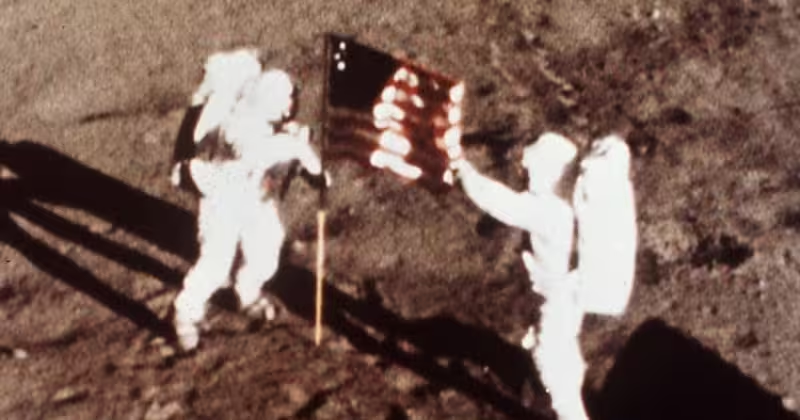
Neil Armstrong’s first step on the Moon still carries the force of a national myth, but one writer says the latest Artemis II mission has left her cold. Áilín Quinlan says the old Apollo 11 moment belongs to a different country, and a different mood.
She said she was only a wee thing when Armstrong exited Apollo 11 and left his boot-print in the moondust, while Edwin “Buzz” Aldrin planted the U.S. flag on the lunar surface in 1969. She remembers the huge sense of excitement and awe that followed, and says the new mission has none of that pull. “The Artemis II adventure has left me cold,” she said, adding that it “has absolutely nothing at all to do with Neil or Buzz.”

The contrast matters because Apollo 11 was never just a spaceflight. Quinlan describes America back then as “a bastion of progress and decency and scientific pioneering,” a revered place, the Land of the Free, with the Moon landing still vivid enough to turn up in The Crown alongside the astronauts’ visit to Buckingham Palace. By the 1970s, even the space-hopper was a world phenomenon: Aquilino Cosani had come up with the toy in the early 1960s after watching a TV documentary about kangaroos, calling it the Pon-Pon, and in America it was sold as The Hoppity Hop.
Her point is that Artemis II has launched from a much bleaker place. “Artemis II, however, has launched from a much bleaker place,” she said, describing America as a now-fearsome land stalked by armed ICE agents, where terrified little children are detained on their way home from school by masked, gun-wielding officers and U.S. citizens are shot in broad daylight by those same government agents. She also called it a place of detention camps, one that bars entry to visitors depending on what is contained in their social media, while the President posts social media rants with the caps lock on.
That is the real divide Quinlan is drawing: not between two rockets, but between two versions of America. The first was a country that could send men to the Moon and be watched with wonder; the second is one she sees as harsher, more fearful and far less easy to admire. For her, that is why the old Neil Armstrong moment still matters and the new one does not.