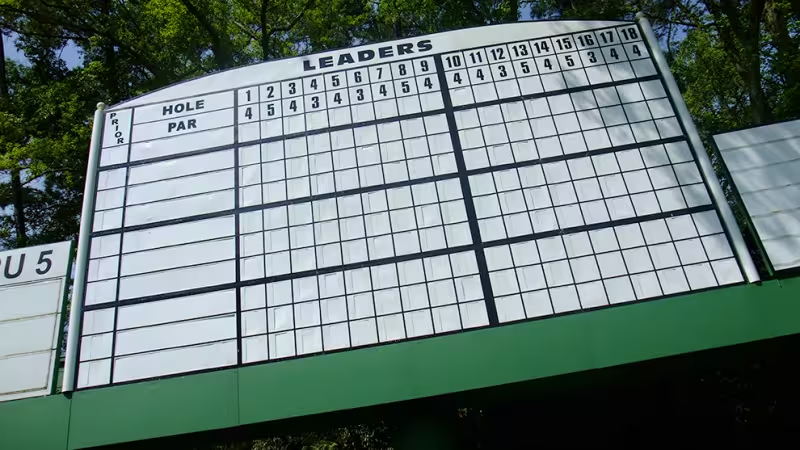
Charlie Kunkle shot a 95 in the final round of the 1956 Masters, a number that still hangs over the tournament whenever the lowest score at the Masters comes up. He began that round with a 7 on the first hole, needed three shots to get out of a trap, and still finished with a score that looked more like survival than golf.
Kunkle’s round broke down in pieces. He three-putted nine times, shot 49 on the front nine and 46 on the back nine, and came in on a day when Augusta National was wrapped in rain, wind and cold temperatures. The 1956 tournament produced the event’s highest winning score, and Kunkle’s 95 became one of the reasons that edition is remembered for how badly the course could beat down even accomplished amateurs.
What makes Kunkle’s score linger is that he was not some outsider who wandered into Augusta by accident. He qualified for the Masters by reaching the quarterfinals of the U.S. Amateur, qualified five times for the U.S. Amateur, and arrived at Augusta having played only nine holes of golf. In 2005, he told the Pittsburgh Press that he earned his way to the Masters. “The record, that’s not important to me,” he said, adding that he was proud to have played in the Masters and that you do not get there by knowing the right people.
The contrast with later numbers keeps the round alive in tournament lore. Nick Dunlap shot a 90 in the first round of last year’s Masters. Billy Casper shot a 106 at the Masters in 2005 before withdrawing before signing his scorecard. Kunkle’s 95 is not the worst number ever posted there, but it sits in a line of scores that show how Augusta National can bring top players to their knees.
That was not the whole of Kunkle’s life. He was the captain of the Duke basketball team in 1936, served on the USS Independence during World War II, was president of a minor-league hockey team, and helped reshape Johnstown’s Sunnehanna Invitational into one of the nation’s premier amateur events. He was also friends with Arnold Palmer and encouraged Palmer to remain an amateur. Kunkle died in 2013 at age 99, but the round he shot in 1956 still gives the Masters one of its strangest and most telling numbers.