Riz Ahmed speeds through Shakespeare in Aneil Karia’s modern-dress Hamlet, playing the prince in a London set adaptation that sends the play into a South Asian community and out onto the city’s roads, bathrooms and boardrooms. The result is a version of the tragedy that moves fast enough to feel breathless, and sometimes too fast to let its relationships settle.
Ahmed delivers the “to be or not to be” soliloquy in a car hurtling down a London highway, playing chicken with oncoming traffic as he speaks. That sequence captures the film’s pulse: urgent, restless and only just in control. It is also the latest iteration of Shakespeare’s play to reach the Toronto International Film Festival, where viewers last year were choosing between Chloë Zhao’s Hamnet and Karia’s Hamlet.
Karia and Ahmed are already linked by their Oscar-winning short The Long Goodbye, and here they turn to a version of Shakespeare that replaces crowns with social power. Hamlet is addressed as “my lord,” Gertrude as “the queen,” even though no one is shown as literal royalty. Instead, Hamlet’s family are real estate barons whose actions have forced citizens into homelessness, a subplot screenwriter Michael Lesslie built into the script and one that gives the drama its sharpest contemporary edge.

The film’s central conflict comes from that pressure on duty and inheritance. Hamlet’s expected fealty to his elders becomes the main source of his guilt and rage, and Karia keeps pushing that idea into stranger territory. Hamlet is often seen rushing into bathrooms or other odd places to deliver soliloquies, while the ghost of his father may or may not be a cocaine-induced hallucination. In this version, the dead father speaks in Hindi and the Bard’s words appear in subtitled English, a choice that roots the story in the community it now inhabits.
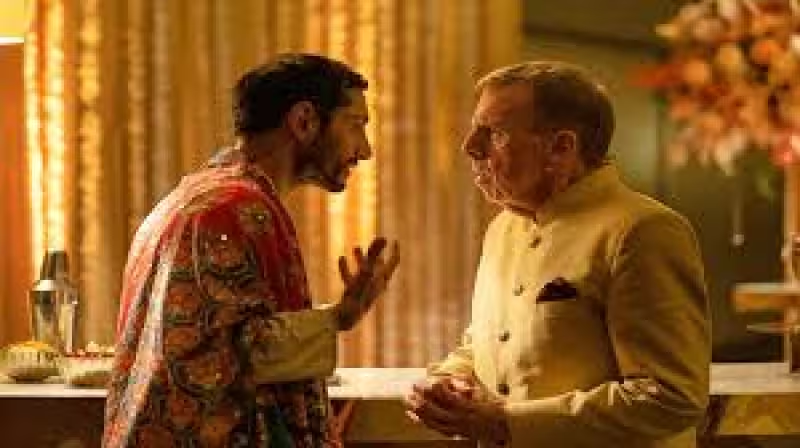
The supporting cast gives the production a familiar Shakespearean frame even as the setting changes around them. Timothy Spall plays Polonius, Joe Alwyn is Laertes and Morfydd Clark is Ophelia. Rosencrantz and Guildenstern do not exist in this version, another sign that the film is trimming and reshaping the play rather than preserving it. Even the play Hamlet hopes will “catch the conscience of the King” has been turned into a dance number, a sequence that shows how far Karia is willing to move from tradition.
That freedom gives the film its best moments, but it also exposes its weakness. This Hamlet runs at just under two hours, and the pace leaves major relationships underdeveloped. The film has ideas, style and a sharp contemporary setting, but it does not always give its characters enough room to breathe. What it does answer is the question of whether Shakespeare can be dragged into modern London without losing his force. In Karia’s hands, with Ahmed at the center, the answer is yes — even if the rush keeps the tragedy from fully landing.