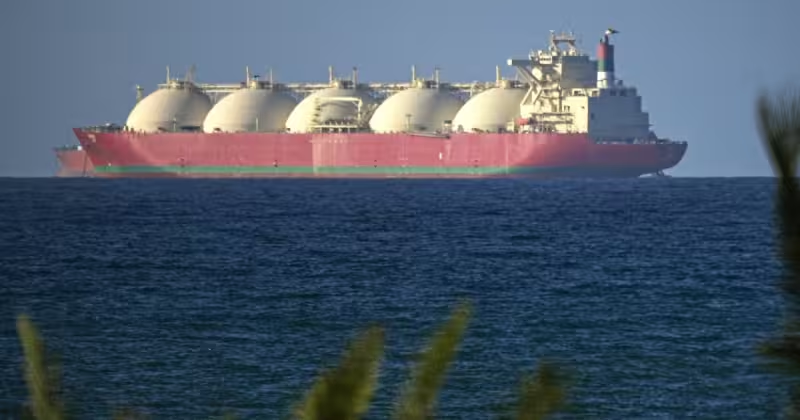
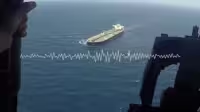
Traffic through the Strait of Hormuz was at a virtual standstill on Thursday, a day after the ceasefire announcement, with only five bulk carriers transiting the waterway in the first 24 hours of the deal. S&P Global Market Intelligence said nine vessels had passed through across Wednesday and Thursday, far below the prewar average of more than 100 ships a day.
The slowdown matters because the strait has long been one of the world’s most important energy corridors, carrying about 20% of the world’s oil and natural gas before the war. The strait hormuz shipping standstill also came as Iran kept pressing its claim over the chokepoint, insisting ships need its permission to pass and suggesting it could charge a fee for transit.
Iran’s approach to the waterway hardened during the war. It attacked several vessels and vowed to strike any ship it viewed as linked to the United States or Israel. Late Wednesday, the Iranian navy released a map that appeared to show it may have mined the strait and set out designated lanes for traffic. Outbound ships leaving the Persian Gulf were directed along a route just south of Larak Island, while inbound vessels were told to follow a route north of Larak Island. Those lanes ran closer to Iran’s mainland than the route many ships used before the war, and a large portion of the strait was marked hazardous.
Iranian officials framed the warning as a safety issue. Saeed Khatibzadeh said in an interview published Thursday, “We have to be very careful for the security and safety of tankers and vessels.” In a LinkedIn post the same day, Sultan Al Jaber said, “This moment requires clarity. So let’s be clear: the Strait of Hormuz is not open. Access is being restricted, conditioned and controlled.”
Beyond the Iranian warnings, the day also brought signs that outside powers were preparing to step in. French Foreign Minister Jean-Noël Barrot said the European Union and its partners were finalizing plans for a mission to escort ships, adding, “Work is well advanced” for the deployment once calm has been fully restored.
The exact number of vessels moving through the strait remains uncertain because some ships turn off or spoof their GPS trackers while transiting, but the picture is clear enough: the flow has not come close to the “total reopening” President Donald Trump demanded as a condition for the truce. For now, the world’s most sensitive maritime passage is open in name, but not yet in practice.