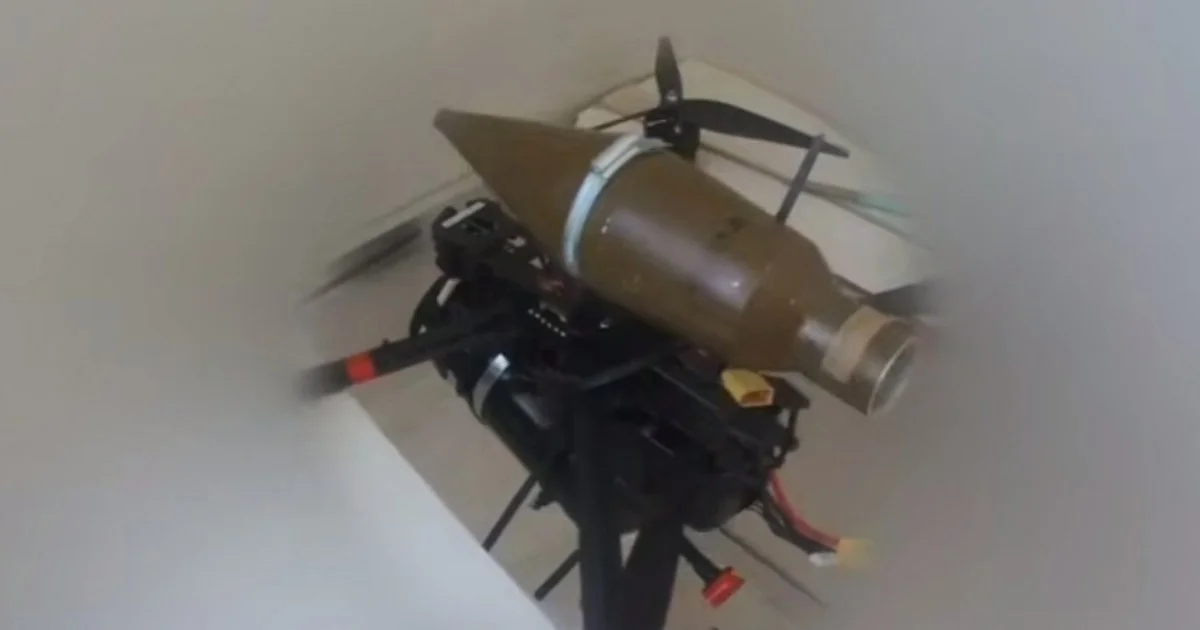
Hezbollah has begun using first-person view attack drones guided by a physical fibre optic cable, a tactic that has already killed an Israeli soldier and exposed a hole in one of the battlefield’s most expensive defenses. The drones, tethered to an operator’s control station by a thin thread, can be flown 10 km to 30 km and are largely immune to Israeli electronic warfare because they do not rely on a wireless signal.
The aircraft are built from lightweight fibreglass and give off almost no thermal or radar signature, while high-resolution optical cameras send uncompressed video back through the cable. That allows operators to manually steer the fiber optic drone into weak points such as a tank’s turret or tracks, and Hezbollah has already used the method to bypass the Trophy active protection system mounted on Israeli Merkava tanks.



The most recent example came in Taybeh, where an explosive-laden fibre optic drone killed Idan Fooks and wounded six other soldiers. When an Israeli medical evacuation helicopter arrived, Hezbollah launched two more drones, and one exploded just metres from the aircraft. In Mais al-Jabal on 15 April, two FPV quadcopters with visible fibre-optic links struck the same Merkava tank, with the second hit landing as the vehicle was being towed away by a D9 bulldozer after the first strike had disabled it.
Hezbollah publicly reported the Mais al-Jabal attack on 27/4, and a post dated April 28, 2026, described the group’s fiber optic stealth FPV drone capability. The attacks come amid an escalating conflict in which low-cost aircraft are cutting through Israel’s multibillion-dollar defense systems, forcing Israeli units to improvise. Some combat units have started hanging physical nets, a sign that the response is becoming more makeshift even as the threat becomes more precise.
An Israeli commander currently in Lebanon said there was little his forces could do about the drones, adding that the briefing they get amounts to: be alert, and if you spot a drone, shoot at it. That leaves a battlefield where a cable no thicker than a thread can do what a jammer cannot, and where the next strike may depend less on speed or armor than on whether a crew sees the drone before it reaches the turret ring.