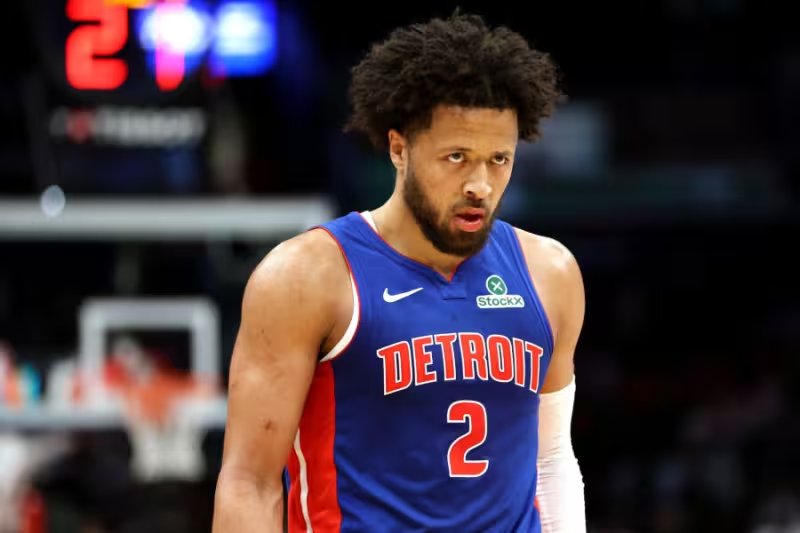
Cade Cunningham came into this playoff run carrying the memory of a season that made him look like an MVP candidate. He averaged 24 points and 10 assists over a six-month stretch, helped Detroit finish 60-22 and claim the top seed in the East, and now the Pistons are one loss from going out in the first round after falling behind the Magic 3-1.
The problem is that Cunningham has not been the same shot-maker. He is shooting 29% from 3, and in this series he has made just 25% of his dribble-jumper 3s. He has also had back-to-back games with more turnovers than made baskets, even while still averaging 29 points per game. That production sounds sturdy until you look closer at how he is getting there. He missed 11 games after suffering a collapsed lung, and the rhythm that made him such a load to handle earlier in the year has not fully returned.
The weight of the numbers is all over Detroit’s offense. Cunningham shot only 52% at the rim in the half-court, the worst mark among 138 players with at least 100 attempts, yet the Pistons still finished with a top-10 offensive rating because he kept getting into the paint and opening easy shots for teammates. That is the basic tradeoff in this series: he is still bending defenses, but not finishing cleanly enough or shooting well enough from the perimeter to keep Orlando honest.

That matters because the roster around him gives the Magic permission to crowd the lane. Detroit finished 29th in 3-point attempts and 17th in 3-point accuracy, and Orlando is packing the paint while daring the Pistons to shoot. Ausar Thompson starts as a non-shooting wing the Magic routinely ignore. Jalen Duren, Tobias Harris and Javonte Green all fit into the same larger problem — Detroit has non-threats across positions, with Duncan Robinson the only real shooter named as a true perimeter danger. The Pistons’ front office looked at Harris, Caris LeVert and Daniss Jenkins as enough ball-handling depth behind Cunningham, then made its biggest deadline move by sending Jaden Ivey to get Kevin Huerter. Detroit also kept all of its future firsts, which left room for second-guessing when better swing factors, such as Ayo Dosunmu without giving up a first-round pick, or bigger names like Trey Murphy or Michael Porter Jr., were available.
The tension is not just that Cunningham is cold from deep. It is that the cold spell has exposed the rest of the structure. He is making 27% of his catch-and-shoot jumpers in the series, down from 35% in his career before it, and his midrange touch has not been enough to cover for the misses. He remains an 84% free-throw shooter and does have real feel on the jumper, but the series has also shown the limits of Detroit’s plan when the star drawing the coverage is not cashing in the shots that defenses are willing to concede. Jalen Duren’s slide tells a similar story. He went from 19.5 points on 65% shooting in the regular season to 9.8 points on 47% shooting in the playoffs, another sign that the paint is where Orlando wants the game played.
That is why Cunningham’s line is so hard to separate from Detroit’s larger season. There was the version that spent six months as an MVP-level problem for opponents, and there is the version that has struggled to score cleanly in this series. If Detroit is going to extend its season, it needs the first one back fast.
For more on his return to the floor earlier this season, see Bucks Vs Pistons: Cade Cunningham Returns as Milwaukee Visits Detroit.