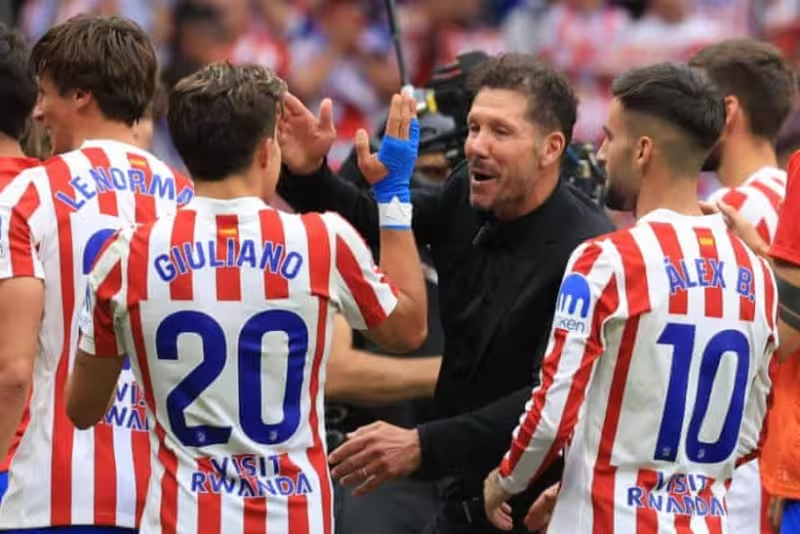
Diego Simeone turned 56 on Tuesday with Atlético Madrid preparing for its biggest game in a decade, and one of the people closest to that story was already part of it long before he played a senior minute. Giuliano Simeone, the youngest son of the coach, grew up around the club, first as a child in the stands and by the bench, and now as a player at the center of the same football life that once looked impossibly far away.
The family link has been visible for years. Giuliano was born in Italy in December 2002, grew up in Argentina with his elder brothers Giovanni and Gianluca, and was carried by his father in December 2004 when Diego bade farewell to the Vicente Calderón as a player. He later became a ballboy at Atlético, visited training at Cerro del Espino in Majadahonda near the family home, and watched from close range as the club he knew from childhood turned into the place where his father built a dynasty.
That memory begins with a cafe in Mar del Plata in December 2011, when Diego asked his eight-year-old son what he thought about returning to Madrid as coach. Giuliano’s answer was a child’s answer, but it carried a clear view of the family’s next step. “You’re going to coach [Radamel] Falcao?!” he asked, before adding: “But … if it goes well, you won’t come back.” It was the kind of instinctive line that made sense in a family already living between continents and clubs.
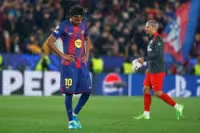
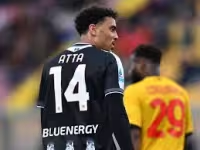

Falcao quickly became the idol. Later, Antoine Griezmann took that place, another sign of how Giuliano’s football imagination was formed in the orbit of Atlético’s best teams and biggest nights. He has said watching the players from so close made it all feel unreal: “It was crazy seeing the players up close.” He added: “I always thought: ‘Imagine being out there; that would be mad.’”
That childhood proximity now sits beside the club’s recent record. Diego has spent almost 20 years at Atlético and led the side into its fourth European Cup semi-final, the seventh overall in the competition, after earlier highs that helped define the era: the Europa League title in 2012, the Copa del Rey in 2013 and the derby win in January 2015. Each milestone was part of the atmosphere Giuliano grew up inside, not as a spectator in the abstract but as someone close enough to see the routine behind it.
The tension in that story is simple enough to see. Giuliano’s life has been shaped by a club his father made his own, but the affection and familiarity do not guarantee anything now that the stakes are higher than ever. The final training session before Atlético’s biggest game in a decade brought the players onto the Metropolitano pitch to greet Diego, a scene that captured both the intimacy of the club and the pressure on the family that has lived inside it for years.
For Giuliano, the line from child to ballboy to player is already written into Atlético’s history. The next chapter will depend on whether the son who once asked if his father would come home can now help keep him, and the club, where they are.