Ronald Wayne is still comfortable with the decision that cost him a place in one of the richest companies in history. At 91, the third signature on Apple’s founding document says he has no regrets about selling his 10% stake back for $800 in 1976, then taking another $1,500 to formally give up any future claim to the company.
“My success has never been defined by money,” Wayne said. “It’s been defined by acting with clarity, integrity, and sound judgment, given what I actually knew at the time.”
That answer lands differently now because Apple’s market cap is hovering around $4 trillion, a figure that turns Wayne’s old share into a theoretical fortune worth more than $400 billion. But in 1976, Apple was anything but a sure bet. Steve Jobs had taken out a $15,000 loan to fulfill the company’s first order from a Bay Area computer store, and Wayne knew that store had a shaky reputation for paying its bills.
Wayne was working as an engineer at Atari when Jobs recruited him to help persuade Steve Wozniak to build a computer company. He drafted Apple’s original partnership agreement, and for a brief moment the arrangement gave him a 10% stake, with Jobs and Wozniak each holding 45%.

He also had more to lose than the others. Wayne already owned a house, a car and personal assets he feared could be seized if the business failed. He later warned entrepreneurs to understand exactly what they are agreeing to, especially in a general partnership, where each partner can be held responsible for the full amount of any obligation.
“Understand exactly what you are agreeing to, particularly in a general partnership, where liability is not limited to your ownership percentage,” Wayne said. “Each partner can be held responsible for the full amount of any obligation. Understand your risk in practice, not just on paper. Have counsel. And never assume your exposure ends at your percentage, because it doesn’t.”
After leaving Apple, Wayne spent decades working as an engineer and living a relatively quiet life far removed from Silicon Valley. He eventually settled in Nevada, relied heavily on Social Security and occasionally sold rare stamps and coins. He said his perspective has become much clearer over the past year as he came to understand how far the public story has drifted from the facts.
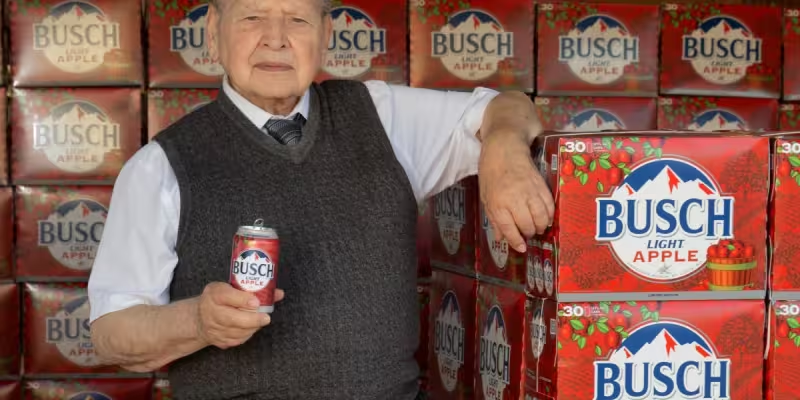
Earlier this month, Wayne surfaced again in an unlikely setting: a promotional campaign with Anheuser-Busch for the return of Busch Light Apple, a limited-edition beer. In the video, he smiled at a garage full of beer and said, “Let me show you where a man’s wealth really lies.” He followed with, “Yep, still a really good investment.”
The joke works because the math is brutal. Steve Jobs and Wozniak are the names most closely tied to Apple, but Wayne was there at the start, and he chose certainty over a gamble that might have ended very badly. Fifty years later, he is saying the same thing he believed then: the deal he made was the right one for the facts he had.