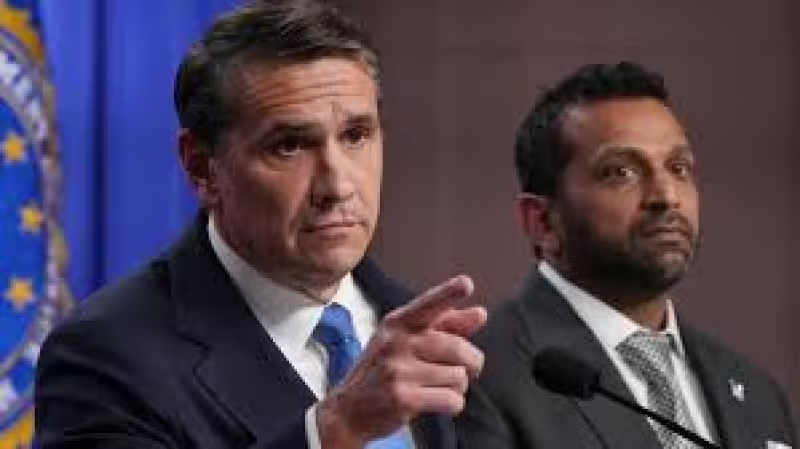
The Southern Poverty Law Center was indicted Tuesday in Alabama on federal fraud charges, with prosecutors accusing the civil rights group of secretly paying informants to infiltrate extremist organizations without telling donors. The charges include wire fraud, bank fraud and conspiracy to commit money laundering.
The indictment alleges that at least $3 million in payments went to informants tied to the Ku Klux Klan, the Aryan Nations, the National Socialist Party of America and other groups from 2014 to 2023. The Justice Department said the center defrauded donors by using their money to fund the same extremism it claimed to be fighting.
That accusation cuts to the heart of the organization’s long anti-extremism campaign. Founded in 1971 by Morris Dees, the Southern Poverty Law Center began in the 1980s by tracking white supremacist groups through an effort first called Klanwatch, later renamed the Intelligence Project as it expanded beyond the Ku Klux Klan. The center’s endowment had just under $732 million in hand as of last October.

Bryan Fair said the payments went to confidential informants so the center could monitor threats of violence from extremist groups, and that the information was frequently shared with the FBI and other law enforcement agencies. He said the information gathered by the informants helped save lives, and added, “We are outraged by the false allegations levied against SPLC.” The center also said the program was kept quiet to protect the safety of informants.
The case puts the group’s own history under a harsher light, even as that history includes a direct attack on its work. On 28 July 1983, members of the Ku Klux Klan tried to burn down the center’s Montgomery offices, damaging the building, office equipment, the law library and files. More than a year later, three KKK members were arrested in connection with the blaze, pleaded guilty and were sentenced to prison.
The indictment now forces a simpler question than the one the center has spent decades asking of others: whether its secrecy was a necessary shield for dangerous work or a fraud on the donors who paid for it. The answer will likely turn on what prosecutors can prove about where the money went, and why the center said so little about it.