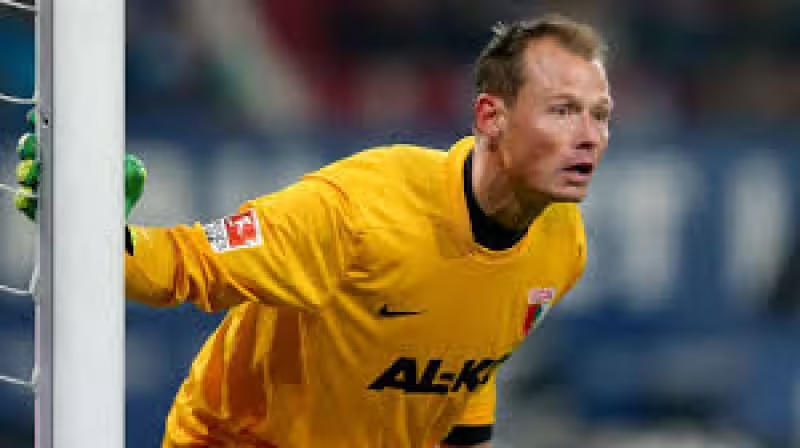
Alexander Manninger died on Thursday after the car he was driving was hit by a train at a railroad crossing in Salzburg, Austria. He was 48.
First responders found Manninger had already been pulled from the car when they arrived, but emergency personnel were unable to resuscitate him. Investigators have preliminarily determined that the car was dragged by the train after impact.
FC Red Bull Salzburg posted a tribute on April 16, 2026, mourning the former player and sending thoughts to his family and friends. The Austrian Football Association’s sporting director, Peter Schöttel, called Manninger a great ambassador for Austrian football on and off the pitch, saying he set a benchmark in his international career and inspired and shaped many young goalkeepers. Schöttel also said Manninger’s professionalism, calmness and reliability made him an important part of his teams and the national team, and that his achievements were worthy of the highest respect.
Manninger began his professional career with Arsenal and spent four seasons there, including the 1997-1998 campaign when the club won the EPL title. He made 39 appearances with 38 starts in his EPL career before moving to Serie A in Italy, where he played for three teams. He started 38 games for Siena in the 2006-07 season, spent the 2008-09 and 2009-10 seasons at Juventus, then moved to Augsburg in the German Bundesliga for four seasons before ending his club career at Liverpool. He did not make an appearance in the 2016-17 campaign.
He was capped 33 times by Austria and made eight starts in World Cup qualifiers in 2006 and 2010, with four starts in each qualifying period as Austria won two and drew three of those matches. Manninger was also part of Austria’s squad at the 2008 Euros, the country’s first European championship, which it co-hosted with Switzerland. His death removes one of the most familiar names from a generation that carried Austrian football onto a bigger stage.